Do you dream of developing technologies to automate repetitive tasks? Or smart tech solutions that help companies fast-track their growth journey?
If yes, then you should consider a career in Artificial Intelligence (AI) Engineering.
A degree in computer science or related fields, with a focus on AI and Machine Learning (ML), offers high-paying job opportunities to students. What was once a futuristic concept is now becoming an integral part of daily operations.
Every day, businesses require skilled professionals to process large datasets to predict the outcomes of their strategies. Since manually processing large datasets can be a daunting task, businesses want professionals to include modern technologies to automate the repetitive tasks.
That’s when AI professionals step in. A degree in software engineering or AI engineering will help gain foundational knowledge in AI and ML. Moreover, it will equip them with technical and practical skills to solve real-world problems.
If you’re passionate about using AI to accelerate business operations, then you’ve come to the right place.
This blog will explore the scope of artificial engineering across sectors such as healthcare, finance, education, and transportation. Furthermore, it will discuss salary trends and skills to help you explore a wide range of jobs at top organisations.
Key Takeaways
To build a career in AI engineering, knowing its key aspects is essential. These are as follows:
- AI blends programming languages to mimic human actions.
- General AI, Super AI, and Reactive Machines are crucial types of AI.
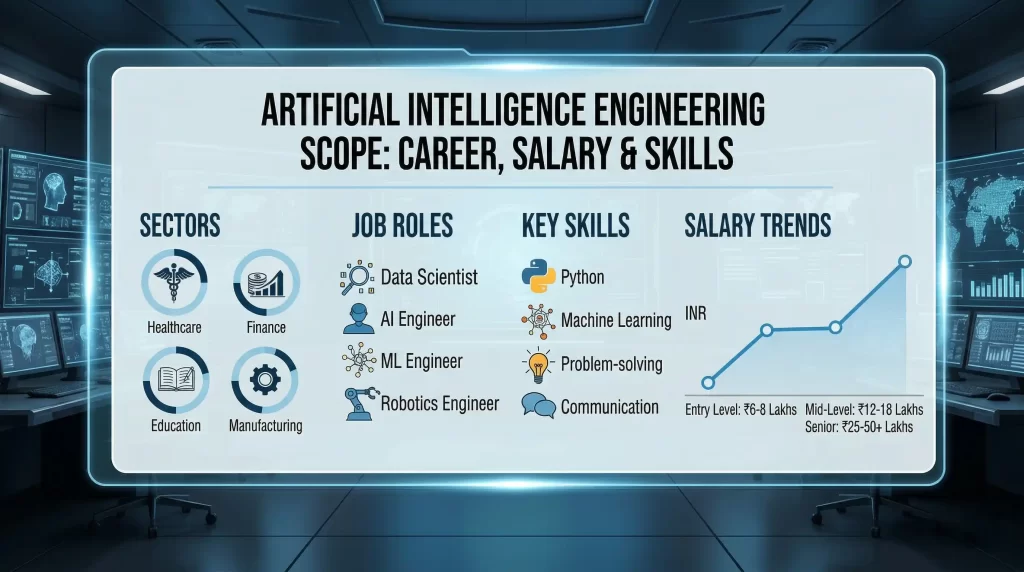
- The field offers enormous opportunities as a data scientist, artificial intelligence (AI) engineer, or robotics engineer in healthcare, manufacturing, and education.
- The entry-level salary for an AI engineer is INR 5 LPA- INR 12 LPA.
- Amazon, Genpact, and Accenture are among the top companies hiring for AI positions
What is Artificial Intelligence Engineering?
Artificial Intelligence is the simulation of human intelligence in machines, a breakthrough in computer science. Blending programming languages, these machines think like humans and mimic their actions.
Unlike traditional software, which processes data, AI uses data and algorithms to recognise patterns and make autonomous decisions. Moreover, the discipline involves several key aspects, such as:
- Machine Learning (ML): It involves systems that use historical data to improve operations without programming for every task.
- Deep Learning: A subset of ML that uses artificial neural networks to analyse complex data patterns.
- Computer Vision: Allow computers and related technologies to see, interpret, and analyse visual data from the world.
- Natural Language Processing (NLP): It is the way machines understand, interpret, and generate human language.
What do AI engineer professionals do?
AI professionals are experts who understand algorithms and data, and train machines to perform like humans. Since businesses want speedy operations, machines can take on the responsibility of performing repetitive tasks. With AI professionals, they can achieve optimum results in gaining access to accurate data for better performance.
Moreover, AI professionals are responsible for:
- Building, training, and deploying machine learning models that allow machines to learn from data.
- Creating new algorithms and exploring tools and technologies, such as deep learning.
- Overseeing strategic development for AI-based products.
- Analysing complex datasets to identify trends and patterns for businesses to make informed decisions.
Types of Artificial Intelligence (AI)
After understanding what AI is and the responsibilities of the professionals, learning about its types is crucial. The different AI types allow engineers to select the appropriate and technically sound solution. As you figure out the solution, it will help you solve complex business problems. Moreover, it will expand the scope of artificial intelligence engineering into specialised fields.
Here are the different types of AI:
- Basic/Narrow AI: Most AI is narrow or basic, intended for specific tasks. These include systems like language interpreters and recommendation systems.
- General AI: It is a type of AI that can perform a wide range of activities, much like a human. Professionals design and develop various ML models that offer understanding and learning capabilities.
- Super AI: Though it remains speculative, Super AI will surpass human intelligence. It will involve robots or chatbots that develop desires, emotions, and beliefs of their own.
- Reactive Machines: These AIs make decisions or take actions based on real-time input. However, they lack memory or learning capabilities.
- Limited Memory AI: It is a type of AI that helps to improve future responses from past data. Machine learning models, particularly robotics and autonomous systems, use historical data to make predictions. However, they don’t have a lasting memory.
- Self-Aware AI: Advanced AIs with awareness and self-consciousness. Using such capabilities, the machines can pursue goals on their own based on their understanding of the world around them.
Exploring the Scope of Artificial Intelligence in Different Sectors
Businesses worldwide want to streamline their operations. While traditional software made life much easier, it still has shortcomings when it comes to predictive data. With AI, every sector, ranging from healthcare to education, can enhance its decision-making abilities.
All these industries also demand professionals who can leverage AI power to build transformative solutions. Let’s explore the possibility of AI in different sectors, such as:
Education
In the education industry, AI can help create personalised learning. Teachers can use AI to adapt to each student’s progress. It thus helps them automate repetitive tasks, such as grading. As a result, instructors have more time to guide students.
Healthcare
AI speeds up and improves surgical precision. When professionals blend AI tools, they can identify ailments early. Moreover, the healthcare sector can analyse patient data more quickly, allowing doctors to take prompt action and provide individual patient care.
Finance
Solving client queries manually can take a lot of time. With AI capabilities, such as chatbots, banks and other financial organisations can resolve client queries quickly. Furthermore, AI is transforming investment management by automating most tasks. It also helps detect fraud, giving clients peace of mind.
Manufacturing industry
AI in the manufacturing industry enables the performance of monotonous jobs. They also help detect equipment malfunctions before they occur. Such capabilities help reduce production costs and downtime, enabling a rewarding scope for artificial intelligence.
Agriculture
The Indian agricultural landscape was highly dependent on conventional methods. But with the advent of AI, many things have become easy for individuals. AI helps forecast behaviour to know whether parasites are breeding in the crops. As a result, farmers can take prompt action.
Transportation
There is a significant scope for AI and ML engineering in the transportation sector. Autopilot has been used for a long time in aircraft, ships, and spacecraft. With AI, many companies are looking for engineers to design and develop autonomous cars that rely on ML models.
Energy and Environment
AI is transforming the energy and environmental sectors by offering modern tools for data analysis and automation. It also involves prediction capabilities to understand climatic changes. It therefore helps professionals develop better mitigation strategies. Moreover, it processes large datasets from IoT Sensors and satellite imagery to optimise climate change research.
Retail
In the retail sector, AI plays an important role in predicting client demands. It analyses previous purchases to create a tailored shopping experience for the professionals. With demand anticipation, it controls inventory to raise the overall customer satisfaction.
Entertainment and Media
Producing unique content every day can be time-consuming. By blending human creativity and AI capabilities, the entertainment sector can automate content production. Moreover, they personalise user experience through targeted advertising and AI-based scriptwriting. It thus helps reduce costs and enhance engagement for media companies and streaming platforms.
Cybersecurity
There is a significant scope for artificial intelligence and data science in the cybersecurity industry. The scope of cybersecurity also expands as the threat from hackers grows; AI helps keep business information secure. Using data science principles, professionals deploy AI-driven machines to transfer data into cloud networks.
Exploring Career Scope in Artificial Intelligence
As you learn the significance of AI across different sectors, it is evident that it is a growing field in the coming years. Using AI-based tools, professionals take on responsibilities such as developing algorithms and ML models and analysing datasets.
Whatever responsibility you seek, ensure it aligns with your interests. With growing demand for data analysis, automation, and innovation, the career scope in AI is immense.
These career opportunities include:
Data Scientist
Data scientists develop predictive models to theorise and forecast business patterns and outcomes. They are responsible for determining which questions a team should ask and for helping them frame answers using data.
Artificial Intelligence (AI) Engineer
AI engineers use AI and machine learning techniques to develop applications and systems that help organisations become more efficient. They focus on developing the tools, systems, and processes that enable the application of AI to real-world problems. Data trains algorithms, helping them learn and perform better. AI engineers can help cut costs, increase productivity and profits, and make business recommendations.
Artificial Intelligence engineers use AI and ML techniques to develop applications and systems that allow organisations to become more efficient. They train algorithms that allow systems to learn and perform better. Such tasks help cut costs and offer a rewarding scope in artificial intelligence and machine learning engineering.
Machine Learning Engineer
Machine learning engineers research, design, and develop the AI responsible for machine learning. They collaborate with other data science team members who are responsible for building AI models. They perform tests and statistical analysis to improve existing AI systems.
Natural Language Processing (NLP) Engineer
Natural Language Processing (NLP) engineers design, develop, and implement AI systems to analyse, interpret, and generate human language. They combine computer science, AI, and linguistics to develop applications such as sentiment analysis, chatbots, and translation tools.
Computer Vision Engineer
A computer vision engineer develops algorithms and models for computers, enabling them interpret visual data from images and video. They utilise image processing techniques and programming languages such as C++ and Python for facial recognition and autonomous vehicle applications.
Robotics Engineer
These AI professionals develop robotic applications across industries such as healthcare, manufacturing, and transportation. Robotics engineers build new products and assemble prototypes for testing, while monitoring their performance in real-world scenarios.
Data Engineer
Data engineers create systems that collect, manage, and convert raw data into usable information. They act as liaisons among business analysts, data scientists, and other professionals, interpreting data and making it accessible to organisations. After analysing the datasets, organisations optimise their performance.
Software Engineer
Software engineers, also known as developers, create software for computer applications. They use programming languages, architects, and platforms to create anything from network control systems to computer games.
AI Product Manager
These professionals are responsible for overseeing the development of AI-driven products, including training models and feedback loops. They also act as a bridge between technical teams and business stakeholders to address bias and manage backlogs.
AI Consultant
They are specialists who help businesses identify, design, and implement AI solutions. Such a task boosts business efficiency, increases revenue, and provides roadmaps to solve complex problems.
Big Data Analyst
Big data analysts examine complex datasets to uncover market trends, hidden patterns, and actionable insights. Using these elements, businesses can make informed decisions. Moreover, these professionals utilise data mining and predictive modelling to enhance fraud detection and operational processes.
Business Intelligence (BI) Developer
They are responsible for designing data models and maintaining data warehouses. With strong proficiency in programming languages, these professionals can explore the scope of AI and data science engineering. Moreover, they manage data visualisation tools to convert the data warehouse into strategic business intelligence.
Algorithm Developer
Algorithm developers design, implement, and optimise reliable algorithms to solve computational problems. They use programming languages like Python, Java, and C++ to refine data-driven solutions. Furthermore, these professionals use algorithms to enhance software performance and system functionality.
UI/UX Developer
These professionals merge user experience (UX) with user interface (UI) design to create visual elements of applications and websites. They are responsible for coding and designing intuitive interfaces that focus on interaction, user flow, and responsiveness.
AI Engineer Salary in India 2026: By Career
The vast career options in AI broaden the scope of engineering in the present times and the future. With technological development, every sector aims to create systems that enhance business efficiency. The requirement for skilled professionals thus makes AI a lucrative career path.
However, the salary structure varies by job title and responsibilities. Let’s understand the salary scope in 2026 for an AI Engineer by career:
| Job Profiles | Responsibilities | Salary Trends |
| AI Engineer | AI model development Data handling Optimisation and evaluation | INR 5 LPA- INR 12 LPA (0-2 years) INR 12 LPA- INR 20 LPA (3-5 years) INR 20 LPA- INR 50 LPA (5-10 years) |
| ML Engineer | Data preparation System design and implementation Collaboration | INR 4 LPA- INR 10 LPA (0-2 years) INR 8 LPA- INR 20 LPA (3-5 years) INR 20 LPA- INR 40 LPA (5-10 years) |
| Data Scientist | Data collection and preparation Data visualisation Reporting | INR 4 LPA- INR 14 LPA (0-2 years) INR 10 LPA- INR 20 LPA (3-5 years) INR 20 LPA- INR 40 LPA (5-10 years) |
| Robotics Engineer | Design and development System integration Maintenance and troubleshooting | INR 4 LPA- INR 7 LPA (0-3 years) INR 10 LPA- INR 18 LPA (4-10 years) INR 20 LPA- INR 35 LPA (10+ years) |
| AI Product Manager | Manage model lifecycle Cross-functional leadership Performance evaluation and monitoring | INR 12 LPA- INR 18 LPA (0-3 years) INR 20 LPA- INR 40 LPA (4-7 years) INR 40 LPA- INR 50 LPA (8+ years) |
Companies Currently Hiring AI Positions
Now that you know the salary trends of AI career options, it is evident that the discipline holds a promising future. As every sector relies on AI, more companies are hiring individuals to develop algorithms and models for these systems.
The companies that are currently hiring for AI professionals include:
- EY (Ernst & Young)
- Tata Consultancy Services
- Amazon
- Turing
- Genpact
- Accenture
AI’s Impact on Job Markets and Workforce Transformation
AI is rapidly transforming the workforce and the job market in AI by creating new job roles and enhancing productivity. Since businesses demand their machines to perform complex operations, it takes professionals to train the systems.
That’s how AI creates opportunities for ethical experts and data scientists to collect, interpret, and analyse data.
Moreover, AI fosters transformation in the job sector through the following ways:
- It projects new hiring to train new systems for predictive analytics, facial recognition, and related areas.
- AI heavily impacts routine tasks like data entry, scheduling, and customer support.
- While technology and financial services rely on AI for fraud detection and data extraction, other industries, such as healthcare and manufacturing, also use AI to analyse patient data and detect equipment malfunctions.
- AI blends human-centric skills to develop advanced systems. Professionals using their creativity, empathy, and computational skills are creating systems that run faster and more closely mimic human emotions.
Skills & Certifications You Require for an Artificial Intelligence Engineer
Building a career in AI involves a combination of skills and certifications. These include technical and workplace skills that enable professionals to build AI systems across industries such as finance, education, healthcare, and manufacturing.
Technical skills
Many AI jobs rely on proficiency in coding and programming languages. With coding capabilities, you can expect to work on various computer systems. Some key technical skills to build a career in AI include:
- Python
- C++
- Industry knowledge
- Microsoft Azure AI
- Data acquisition systems
Workplace skills
Other than technical skills, you can acquire some workplace skills to advance your career in AI. Usually, it hones through years of experience. The following are the workplace skills that will boost your AI opportunities:
- Problem-solving
- Communication
- Collaboration
- Management
- Leadership
- Analytical thinking
Certifications
Students with an undergraduate degree in AI/computer science or a related field can enrol in courses to learn technical skills. However, even without an undergraduate degree, you can pursue certification programs like:
- Google Advanced Data Analytics Professional Certificate
- IBM AI Engineering Professional Certificate
- ARTIBA: Artificial Intelligence Engineer
- IBM AI Developer Professional Certificate
Advantages and Limitations of Artificial Intelligence
After gaining the skills to become an AI professional, it is time to consider the program’s advantages and limitations.
It is necessary to understand both the pros and cons of AI to make an informed decision.
Advantages of Artificial Intelligence
AI offers transformative advantages across industries. Through predictive models, businesses can improve efficiency and decision-making. The advantages of AI include:
- Performing monotonous jobs rapidly to free up individuals working on more complex projects.
- 24/7 customer support and monitoring other functions without getting tired.
- Evaluating huge volumes of data to find patterns and insights would take much longer for humans.
- Adjusting to user preferences to enhance their experiences on e-commerce sites and streaming platforms.
Limitations of Artificial Intelligence
Though AI holds transformative potential, the field faces certain challenges. These limitations are as follows:
- The creation and deployment of AI systems can be costly and require a level of investment that few businesses can afford.
- AI’s lack of human emotions may prevent it from fully comprehending the intuitive nature of humans, their creativity, and cultural quirks.
- AI’s reliance on data raises privacy concerns and ethical and security issues.
- Automation capabilities may replace some occupations, especially those that require routine tasks.
The Future of Artificial Intelligence
The developments in General AI mark a groundbreaking future for artificial intelligence and data science engineering. Moreover, AI can fully harness its potential by collaborating with different stakeholders.
AI professionals are also working on self-improving systems that will enable essential models to adapt autonomously. As a result, it will minimise the need for frequent training.
Moreover, it will enable machines to achieve human-like cognitive abilities, allowing them to perform a wide range of tasks without human intervention.
How does Career Planner Edu Fair Help to start a Career in Artificial Intelligence Engineering?
Mimicking human activities in machines can speed up business operations. That’s what artificial intelligence does. Since businesses across sectors demand rapid operations, the scope of artificial intelligence engineering is rewarding.
All you need is the right skill set to build a successful career as an AI engineer. Moreover, its need for data collection and predictive analysis also offers opportunities for data scientists and ML engineers.
To understand the career path in AI, it is essential to know the right direction to take. With Career Planner, you can embark upon finding a rewarding career in AI.
Our educational fair is a hotspot for students, parents, and industry experts to meet and plan a career path. We provide pre-enrolment counselling that will help you figure out a course that will help build an effective career in AI.
Join our educational counselling and explore a transformative career in AI engineering.
FAQs
Does artificial intelligence have a scope?
Yes, artificial intelligence has a long-term scope across sectors like manufacturing, finance, healthcare, and transportation. By automating repetitive tasks, it is transforming the job market, offering a range of roles in data science, machine learning, and robotics.
Is an AI engineer a high-paying job?
Yes, AI is a high-paying job in the tech industry. The demand for developing transformative revenue-generating technologies requires skilled professionals. As the world continues to face a shortage of professionals, an AI engineer has become one of the most lucrative career options.
Which 3 jobs will survive AI?
The three jobs that will survive AI include energy experts, biologists, and developers. Of course, AI technologies will handle repetitive tasks more quickly, but these roles require some level of strategic thinking, human-level creativity, and an understanding of context.
Is artificial intelligence a good career?
Yes, artificial intelligence is a good career because it automates bulky operations. As a result, businesses can ensure speedy deliverables. By leveraging data analysis, machine learning, and research, professionals can use AI capabilities to work more effectively, making it a promising field.
What is the AI engineer’s salary in India?
The AI engineer salary in India is highly competitive, ranging from INR 11 LPA to over INR 35 LPA. Depending on experience, location, and skills, salaries usually vary.
Does AI engineering have scope in the future?
Yes, indeed, the future scope of AI Engineering is very strong. In 2026, there is a huge surge in the demand for jobs in AI-related positions, with job postings rising by over 130% and AI skills featured in almost 78% of technology jobs, and so forth.
What skills and background do I need to pursue a career in artificial intelligence engineering?
To pursue a career in artificial intelligence engineering, you should have technical expertise in mathematics, machine learning, and programming. Furthermore, it is essential to have a foundational background in computer science/engineering. As AI continues to evolve, students must develop practical skills in cloud computing, model deployment, and generative AI. All these skills will help them get better employment opportunities.