
Are you looking for a career after 12th that protects digital assets from cyber threats? You can then pursue a career in cybersecurity. It is a field that enables professionals to identify threats across network systems, cloud platforms, and software, and protect them at all costs.
As cyber threats are evolving in complexity and reach, businesses require skilled professionals to protect their data and infrastructure. A cybersecurity professional analyses data or networks to generate threat intelligence.
For that, they require profound theoretical knowledge and practical skills. To gain those skills and knowledge, they can seek degree programs or certifications in cybersecurity.
As they complete the program, they can use these skills to solve real-world problems, including those related to malware and phishing. It will allow them to explore job opportunities as a security analyst, application security engineer, or ethical hacker.
If you are passionate about threat detection in data infrastructure and network systems, then you have come to the right destination.
This blog will explore the scope of cybersecurity and the diverse career opportunities it offers. Moreover, it will discuss salary prospects and future trends, helping propel your career in the right direction.
Key Takeaways
Building a career in cybersecurity is a dream for many students. For that, you should know the following key facts:
• Cybersecurity is the practice of protecting an organisation’s digital assets from unauthorised access.
• Malware, phishing, and ransomware are common cyber threats that can damage an organisation’s intellectual property, systems, and hardware components.
• The top career options in cybersecurity include security analysts, cloud security architects, and incident responders.
• Quantum computing and blockchain are the future trends in cybersecurity.
• Entry-level professionals can earn between INR 4 LPA and INR 8 LPA as an Information Security Analyst.
What Does Cybersecurity Mean and Why Does It Matter?
Cybersecurity is the practice of protecting networks, systems, data, devices, and programs from digital threats, attacks, or damage. As businesses rely on digital technology for daily operations, they require skilled individuals to protect their data infrastructure, systems, and networks. That’s when cybersecurity professionals come to play.
They combine a series of technologies, processes, and human awareness to defend against unauthorised access. Furthermore, these professionals ensure data confidentiality, availability, and integrity by testing for vulnerabilities and monitoring security breaches.
Why is cybersecurity important?
Since most businesses now operate online, they want professionals to protect their digital assets and devices. That’s why cybersecurity becomes essential. Moreover, cybersecurity is a demanding career because:
- The field reduces the risk of reputation damage, downtime, and financial loss.
- It protects personal, intellectual, and sensitive property from digital theft.
- Cybersecurity experts address the risks posed by Artificial Intelligence (AI) and the Internet of Things (IoT).
- They secure vital services like banking systems, transport, and power grids.
Different Types of Cyber Threats
Now that you know what cybersecurity is and the key role of a cybersecurity expert is, you should learn about the different cyber threats.
Understanding these threats will help you better monitor security breaches. That way, you can protect the organisation’s systems from all kinds of attacks. These are as follows:
Malware: It refers to malicious software such as spyware, trojans, and viruses that unlawfully access networks, devices, and data, causing significant damage.
Ransomware: Software that encrypts a person’s data, with attackers demanding a ransom to restore it.
Phishing: It involves fraudulent emails or messages that trick people into revealing sensitive information, such as financial data or passwords.
Identity-based attacks/spoofing: Impersonating known entities or individuals to steal credentials, such as fake domain usage or business email compromise (BEC).
AI attacks/deepfakes: Using AI to create forged audio or video.
IoT attacks: Infiltrating smart devices (sensors and cameras) with a virus or a Trojan to damage network systems.
What is the Scope of Cybersecurity in India & Overseas?
After learning the different types of cyber threats, you can easily detect them before they damage an organisation’s networks or devices. As digital assets grow in companies, the risk of threats is also skyrocketing. That’s why students explore the scope of cybersecurity.
The massive digitisation boosts the demand for security professionals in India and overseas. It enables students to pursue lucrative careers as cloud security architects and forensic analysts.
Here’s a breakdown of the cybersecurity scope:
- The rise of cyber threats in enterprise systems makes cybersecurity a high-demand career.
- Students can explore well-paying roles such as security consultants, data privacy officers, and cloud security architects.
- The shortage of cybersecurity professionals in India makes it a high-paying career option. Students with senior roles can earn more than INR 30 LPA.
- The rise in cloud adoption and regulatory compliance, such as the Digital Personal Data Protection Act, offers a rewarding scope for cybersecurity.
- Strong demand for data protection exists in Europe, North America, and the Middle East. It thus leads to specialised roles in threat intelligence and incident response.
- With skills in application security and AI-driven security detection, you can pursue an international career in the field.
Top Career Opportunities for Cybersecurity in 2026 and Beyond
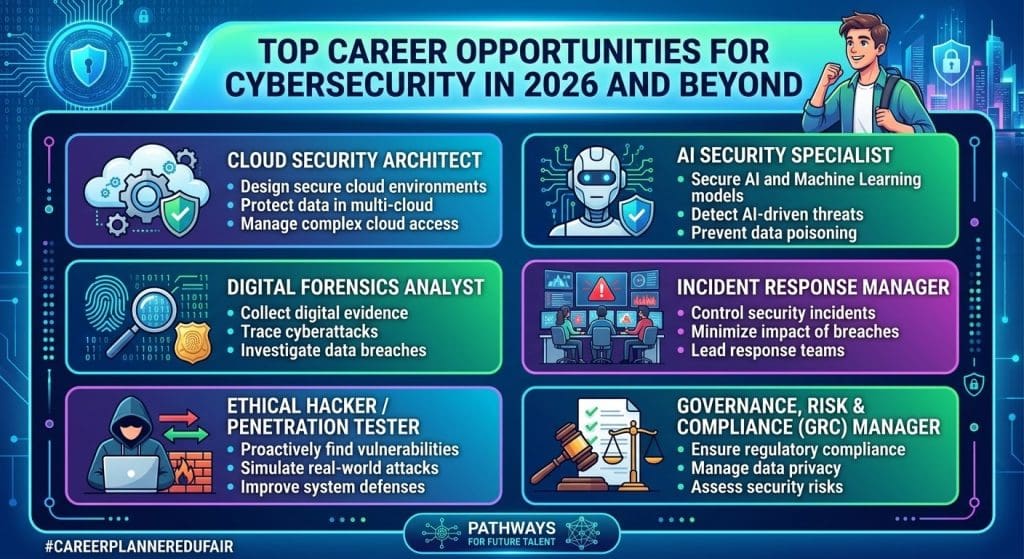
As businesses worldwide require cybersecurity professionals, students are seeking job prospects in this field. From monitoring security breaches to protecting data from threats, these professionals perform various roles.
If you’re passionate about saving data, networks, and business operations from digital attacks, you can look at the career scope in cybersecurity. The roles include:
Security Analyst
Security analysts are the first line of defence in an organisation. They monitor networks and systems for abnormal activity and use SIEM (Security Information and Event Management) tools to analyse data from various sources.
After detecting real threats, they alert Information Technology (IT) teams. It thus allows the teams to exercise strict data protection rules. The continuous need for threat detection ensures security analysts are available in Security Operations Centres (SOCs).
Security Engineer
Security engineers design secure data infrastructure and enforce network segmentation. They are also responsible for deploying controls like logging and encryption to ensure information exchange across all platforms.
These professionals also build tools and scripts like Bash and Python to automate security processes. The automation of tasks thereby allows other security experts to protect cloud environments and applications.
Penetration Tester (Ethical Hacker)
Penetration testers (ethical hackers) break into systems in a controlled manner to detect vulnerabilities. They use the same methods as bad hackers to test networks and web pages.
Such professionals scan the systems to understand how systems can be breached. With that data, the development teams can create robust and secure systems that reduce the risk of unauthorised access.
Cloud Security Architect
The scope of the cybersecurity course is expanding, with roles for cloud security architects. They are professionals who build security policies and reference architectures to protect workloads across multi-cloud ecosystems.
Using tools like AWS (Amazon Web Services) and Azure, they define access boundaries. Moreover, they encrypt data in transit across multi-zone environments.
Application Security Engineer
These professionals protect software by identifying vulnerabilities. To do that, they conduct manual/automated penetration testing (Static Application Security Testing) and DAST (Dynamic Application Security Testing).
Application security engineers also conduct code reviews and perform threat modelling while collaborating with developers to mitigate the risks of cyber attacks. They closely work with development teams to embed security tools into continuous integration (CI) and continuous deployment (CD) pipelines.
Security Operations Centre (SOC) Analyst
SOC analysts monitor triage alerts, real-time telemetry, and respond to active threats. They use automation and playbooks to respond to incidents. Typically, they detect the initial threats and escalate them to other cybersecurity professionals.
Using tools such as Sysmon and Zeek, these professionals identify abnormal traffic patterns across Windows and Linux hosts. They also investigate malware indicators in systems to mitigate the risk of any damage.
Cybersecurity Consultant
As a cybersecurity consultant, you have to deliver security reviews and provide compliance advice. Using your problem-solving abilities, you need to implement best practices across different IT environments.
These professionals further collaborate with development, finance, and legal teams to align security measures with business goals. Their roles further include developing role-based access to facilitate SaaS (Software as a Service) adoption.
Incident Responder
An incident responder works during emergency times. When they detect security breaches in systems, they use digital forensics to investigate and stop them. Since this is an emergency, these professionals need to make prompt decisions.
Typically, incident responders meet data protection rules. They help coordinate recovery efforts and preserve evidence.
Security Software Developer
When you’re exploring a cybersecurity career, you may come across security software developers. These professionals are responsible for automating threat detection. They also ensure report and remediation workflows for security teams.
Their roles blend software development with scripting and threat modelling. By developing browser extensions and entry-point agents, they secure data capture and telemetry.
Cybersecurity Risk Analyst
A cybersecurity risk analyst bridges the gap between technical teams and business stakeholders by assessing vulnerabilities. They identify, evaluate, and mitigate technology risks to protect an organisation’s digital assets.
Their roles include understanding network security to translate complex technical challenges into actionable insights for leadership. To work with both technical teams and business personnel, they require strong communication abilities.
Systems Test Engineer
A systems test engineer ensures integrated systems meet functional requirements, performance standards, and reliability goals before deployment. They design and develop various test plans to improve system efficiency.
They also use simulation and regression to ensure the systems are ready for real-world scenarios. Their close association with product and development teams create high-quality systems.
Network Security Engineer
These professionals design, implement, and monitor security systems to protect a company’s IT infrastructure. They involve firewalls and intrusion detection systems to monitor unauthorised access into the infrastructure.
Network security engineers also include measures to protect sensitive information, such as passwords and financial data, from being leaked. By monitoring abnormal traffic, these professionals expand the scope of information security.
Systems Integration Engineer
The field of cybersecurity offers a range of roles, including system integration engineers. They combine computing systems, hardware, and software into a unified whole. As a result, they monitor whether the data flow is consistent within the systems.
Moreover, they analyse interactions between all these systems to identify, debug, and resolve integration issues. It thus helps all elements function better without interference.
Forensic Investigator
Students with a science background and a passion for detecting digital threats can pursue careers as forensic investigators. They collect digital data from cloud servers, mobiles, and hard drives to uncover evidence for legal, law enforcement, and corporate investigations.
They document findings in detailed reports and provide expert testimony in courts. Using specialised software, they recover encrypted or hidden data.
Skills & Tools Required to Succeed in Cybersecurity
After understanding the career opportunities in cybersecurity, you may decide on one that suits your interests. However, to pursue any of such job roles, you need to have a mix of soft skills, technical skills, and tools.
To become a successful cybersecurity professional, it is essential to learn the following skills and tools:
- Deep knowledge of routers, Linux/Windows administration, and firewalls.
- Proficiency in Python, JavaScript and C++.
- Competence in Google Cloud, Azure, and AWS.
- Understanding attacker methodologies to test and strengthen system defences.
- Having strong communication and problem-solving skills.
- Proficiency in Wireshark for network monitoring/forensics.
- Utilising Qualys for vulnerability management.
- Knowledge of penetration testing tool- Metasploit.
Top Companies Hiring Cybersecurity Engineering Graduates
As you gain experience with different skills and tools in the cybersecurity field, you will increase your chances of securing positions such as a security analyst and a cybersecurity consultant. To pursue such positions, individuals explore the top companies.
Across the finance and energy sectors, the future cybersecurity landscape is quite promising. All these sectors feature remarkable companies, which are as follows:
- Financial Services/Banks: ICICI, SBI, and HDFC
- Healthcare: Apollo Hospitals and Max Healthcare
- Government: National Investigation Agency (NIA) and Cyber Swachhta Kendra
- Defence: DRDO (Defence Research and Development Organisation) and Indian Armed Forces
- Retail and eCommerce: Flipkart and Amazon
- Technology and Software: Infosys and Wipro
- Energy and Utilities: Hitachi Energy and Chevron
Jobs & Salary Expectations in Cybersecurity
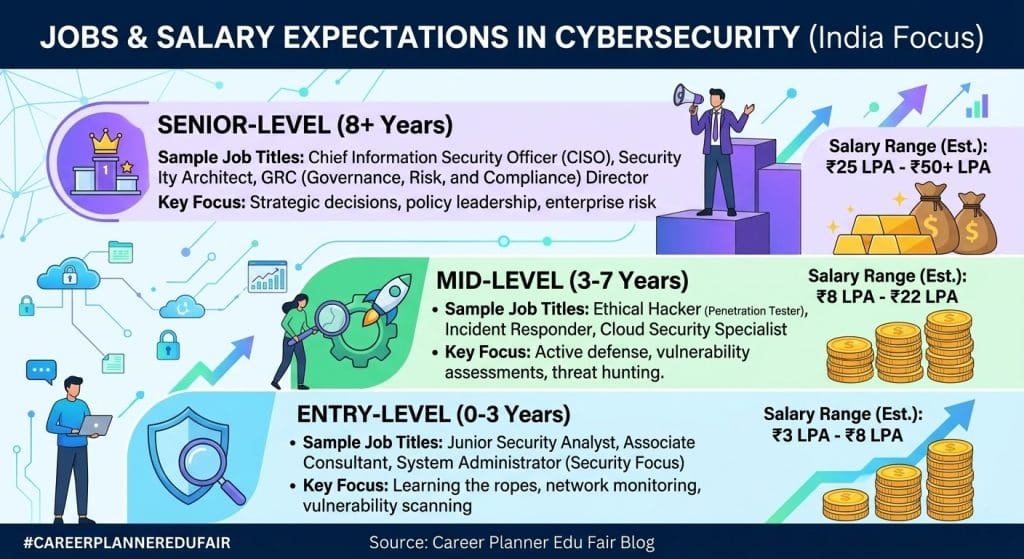
With top companies seeking professionals, it is evident that the scope of cybersecurity is vast. The rising demand to protect an organisation’s network systems, data, and devices makes it a high-paying field.
Usually, the salary range for professionals varies by experience, job role, and complexity. Let’s understand the salary breakdown in terms of experience and different career paths:
Entry-Level Roles
At entry-level positions, cybersecurity professionals perform predefined tasks such as responding to incidents and monitoring systems for threats. These roles consist of:
Job Role | Average Salary Range (India) |
| Information Security Analyst | INR 4 LPA – INR 8 LPA |
| Security Operations Centre (SOC) Analyst | INR 3 LPA – INR 6 LPA |
| Cybersecurity Risk Analyst | INR 4.5 LPA – INR 6 LPA |
| Identity and Access Management (IAM) Specialist | INR 3 LPA – INR 7 LPA |
Mid-Level Roles
Mid-level cybersecurity activities include implementing security strategies, managing projects, and developing safety protocols. They also conduct thorough threat analyses across all systems across various sectors. The salary range for such roles is as follows:
| Job Role | Average Salary Range (India) |
| Ethical Hacker | INR 7 LPA- INR 12 LPA |
| Network Security Engineer | INR 5 LPA- INR 10 LPA |
| Incident Response Analyst | INR 8 LPA- INR 13 LPA |
| Digital Forensics Analyst | INR 5 LPA- INR 10 LPA |
| Cloud Security Specialist | INR 8 LPA- INR 15 LPA |
| Security Software Developer | INR 8 LPA- INR 13 LPA |
Senior-Level Roles
Significant experience, decision-making abilities, and skills are necessary for senior-level cybersecurity roles. The average salary for such positions includes:
| Job Role | Average Salary Range (India) |
| Security Architect | INR 20 LPA-INR 35 LPA |
| Cybersecurity Consultant | INR 15 LPA- INR 25 LPA |
| Malware Analyst | INR 16 LPA- INR 27 LPA |
| Chief Information Security Officer (CISO) | INR 25 LPA- INR 50 LPA |
India salary vs. US salary comparison
The rise of digitisation across sectors also propels the growth of data security and protection. It thus leads to the rise of cybersecurity experts in India and worldwide, particularly in the USA.
Students who wish to pursue a career in cybersecurity must understand the earning potential in both countries. In terms of roles, experience levels, and average salary, you can determine your growth potential as a cybersecurity professional:
| Roles | Experience Levels | Average Salary- India | Average Salary- USA |
| SOC Analyst | Entry-level | INR 3 LPA- INR 6 LPA | $60,000- $90,000 |
| Security Engineer | Mid-level | INR 10 LPA- INR 22 LPA | $1,20,00-$1,60,000 |
| Security Architect | Senior-level | INR 20 LPA- INR 35 LPA | $1,50,000- $1,80,000 |
Educational Pathways to Enter Cybersecurity
The rise in cybercrime creates opportunities for students to explore cybersecurity. That’s why many students consider cybersecurity as one of the best career options after 12th science. But it takes significant education to build a career in such a complex field.
Here we will explore the scope of a job after a cybersecurity course:
- Undergraduate programs: Students require a bachelor’s degree in cybersecurity or related fields to understand the fundamentals of the domain.
- Master’s degree: To improve your chances in higher positions, you can pursue a master’s degree in cybersecurity.
- Certifications: They help establish credibility in cybersecurity. Some of the popular certifications include Certified Ethical Hacker (CEH) and Certified Information Security Manager (CISM).
Future Trends & Scope in Cyber Security
As more technologies emerge, the digital domain will become increasingly complex. As a result, the risk of abnormal activity in the data infrastructure will also rise. It is therefore evident that the future scope of cybersecurity is quite promising. Moreover, it will bring trends like:
- Quantum computing
- Blockchain security
- Zero-trust architecture
- AI in security
Challenges in Cybersecurity Careers
The complexity of digitisation often makes cybersecurity roles quite challenging. They require constant adaptability to new technologies to build a successful career in the field. Let’s look into the challenges you might face in the world of cybersecurity:
- The arrival of new technologies like cloud services, AI, and IoT is rapidly changing the cybersecurity landscape. To stay ahead of any threats, professionals must hone their skills fast.
- Many businesses face budget constraints in setting up cybersecurity measures. The lack of investment makes it difficult for experts to apply their knowledge and hands-on experience to solve problems.
- People in the cybersecurity field handle high-pressure situations, such as preventing attacks and responding to incidents. In such scenarios, professionals need to make quick decisions and work long hours, which can lead to burnout.
How does Career Planner Edu Fair help to start a Career in Cyber Security?
The continuous digital threats compel businesses to rely on cybersecurity experts. Hence, the scope of cybersecurity is quite rewarding. With the growing prevalence of data infrastructure, malicious activities are likely to occur.
That’s why students often choose career options in cybersecurity as security analysts, penetration testers, and security architects. Depending on your experience levels, these positions will provide lucrative salaries.
But the rapid pace of technological change makes it challenging for professionals to find opportunities in cybersecurity. For that reason, you can rely on the biggest educational fair organised by Career Planner.
We provide a forum for students to connect with industry experts based on their interests. Our focus is to help students gain first-hand information about current trends and the scope that aligns with their goals.
Furthermore, we direct you to the appropriate courses that provide insights into your dream career. That way, it will help you get a break in top companies with promising salaries.
Join our edu fair to unlock your possibilities as a cybersecurity expert.
FAQs
What is the scope of cybersecurity?
The scope of cybersecurity covers protecting data, digital assets, and network systems from unauthorised access. It spans strategic, technical, and operational domains due to its high demand on digital infrastructure and rising cyber threats.
Is cybersecurity a high-salaried field?
Yes, cybersecurity is a high-paying career where entry-level professionals can earn INR 4 LPA- INR 7 LPA. As they move up to senior levels, their salaries increase, ranging between INR 30 LPA and INR 90 LPA.
Is cybersecurity a 9-to-5 job?
Cybersecurity is rarely a 9-5 job, as cyberattacks can happen at any time. Usually, professionals are available 24/7 in shifts to respond to emergencies. However, some administrative roles may have standard working hours.
Will AI replace cybersecurity?
AI will not replace cybersecurity. Rather, it will advance the field by automating routine tasks such as threat detection and log analysis. By automating routine tasks, professionals can make strategic and context-specific decisions faster.
Which job is best in cybersecurity?
The best job in cybersecurity depends on your skills and goals. If you have profound knowledge in Azure or AWS, you can pursue a career path as a Cloud Security Engineer. You can also seek a job as an Ethical Hacker, which involves skills in network security.
Is cybersecurity a good career in 2026?
Yes, cybersecurity is a good career in 2026, with its rising demand to protect digital assets. The need for cybersecurity professionals spans the finance, government, and healthcare sectors. As digitisation continues to grow, the risk of cyber threats persists, making cybersecurity a high-paying career.