
After completing 12th grade, the most important task for students is choosing a career path. With PCM (physics, chemistry, and maths) or PCB (physics, chemistry, and biology) combinations, many students opt for engineering jobs.
Due to technological advancements, more industries are demanding professionals to manage them. It thus makes engineering the most sought-after career in 2026.
From infrastructure construction to transportation system design, the discipline offers a wide variety of roles for students. Having theoretical knowledge and practical expertise in the field can help you become a successful engineer.
To gain such expertise, you need to pursue a Bachelor of Engineering (B.E.) or a Bachelor of Technology (B.Tech). These courses will help you explore career options that offer high salaries and other forms of compensation.
Moreover, pursuing these courses will enable you to learn new trends that you can utilise to secure promising roles in good companies from the government and private sectors.
Whether it is traditional domains like civil engineering or emerging fields like renewable energy, the discipline plays a significant role in shaping students’ lives.
If you dream of becoming an engineer, then you’ve come to the right place.
This blog explores the scope of engineering in 2026 for science students. It will also discuss salary trends, top recruiters, and future trends in the discipline.
Key Takeaways
To shape a career in engineering, it is essential to know its key aspects. These are as follows:
- Engineering boosts the growth of problem-solvers that industries demand to design infrastructure or maintain software.
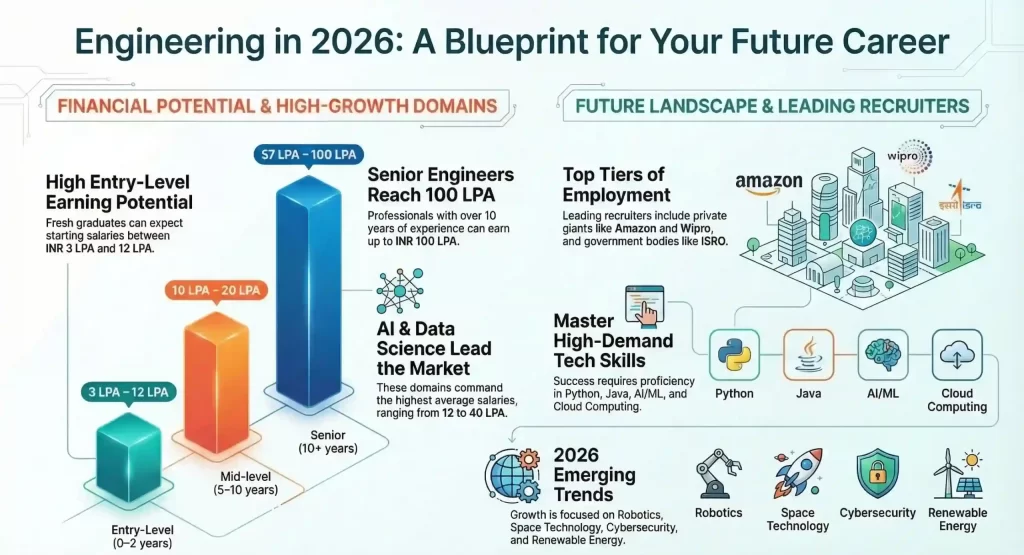
- Engineering graduates can find high-paying roles in private-sector companies such as Cognizant, Amazon, Tata Motors, and Wipro.
- The Government of India provides engineering jobs to students in organisations such as the Airports Authority of India (AAI), the Indian Space Research Organisation (ISRO), and the Defence Research and Development Organisation (DRDO).
- Engineers can earn between INR 3 LPA and INR 12 LPA at an entry-level.
- Robotics engineering, space technology, cybersecurity engineering, and renewable energy engineering are the future trends of the discipline.
- Software Developers, Urban Planners, and Security Architects are top career options that you can explore in engineering fields.
Why Engineering Can Be the Right Career for You?
Most people consider engineering to be the best career option after graduation. If you are passionate about problem-solving and working with innovative tools, the discipline can offer promising job roles.
There are various reasons an engineering career scope can be rewarding:
- Engineering is a highly respected profession. Individuals choosing such career options have a significant impact on their respective industries.
- Students get to work in various sectors with an engineering degree/course. From automation to healthcare, the demand for engineers is everywhere.
- When we talk about the scope of engineering education, innovation is a constant. Individuals interested in creating new gadgets or tools for businesses can make the most of the discipline.
- The demand for engineers is skyrocketing. As technology continues to dominate worldwide, there are immense career opportunities in engineering abroad.
What is the Scope of Engineering in India in 2026?
Science and technology have always had steady growth. Since India is a hotspot for problem-solvers, the scope of engineering in the country is unparalleled in 2026. According to the NAAC 2024-25 data, India has over 7000+ colleges.
From designing huge infrastructure projects to powering Information Technology (IT) systems, engineers play a crucial role. With the presence of Indian software companies, companies demand individuals who can use these tools to the best of their abilities.
That’s why the engineering career is continuously growing in India. Moreover, the trend toward remote work allows Indian engineers to work for international companies without relocating.
By doing so, the professionals can earn promising salaries without travelling to distant locations.
Most Demanding Engineering Fields and Job Opportunities
Engineering is a subject that unlocks the door to a myriad of fields. With the promising scope of engineering in future, individuals can explore plenty of job opportunities.
Below is a table that represents the popular engineering fields and the job roles:
| Type of Engineering | Job Roles |
| Computer Science and Engineering | Network Engineer, Cybersecurity Specialist and Data Scientist. |
| Artificial Intelligence Engineering | Data Engineers, Robotics Engineers and AI Engineers. |
| Electrical Engineering | Power Engineer, Electronics Engineer and Embedded Systems Engineer. |
| Mechanical Engineering | Maintenance Engineer, Design Engineer and Quality Engineer. |
| Civil Engineering | Geotechnical Engineer, Environmental Engineer and Construction Engineer. |
| Biomedical Engineering | R&D Engineer, Biomaterials Developer and Clinical Engineer. |
| Software Engineering | Mobile Developers, Full-Stack Developer and DevOps Engineer. |
| Electronics & Communication Engineering | VSLI Design Engineer, Electronics Design Engineer and Telecom Engineer. |
| Aerospace & Aeronautical Engineering | Propulsion Engineer, Structure Engineer and Aircraft Design Engineer. |
| Chemical / Petrochemical Engineering | Materials Engineer, Chemical Engineer and Project Engineer. |
Career Options after Engineering in Different Industries
Engineering is a vast discipline, and its role is paramount in almost every industry. Interested individuals with an engineering degree can pursue a variety of career options.
The following table will provide career opportunities in different sectors:
| Industry | Career Options |
| Information Technology (IT) & AI | Data Scientist, AI Product Manager, Research Scientist and Robotics Engineer. |
| Healthcare & Pharmaceuticals | R&D Scientist/Engineer, Biostatistician, Clinical Research Associate and Process Engineer. |
| Manufacturing | Design Engineer, Production Engineer, Supply Chain Specialist and Quality Engineer. |
| Finance & Banking | Software Development Engineer, Credit Analyst, Internal Auditor and Financial Specialist |
| Education | Teacher/Professor, pursuing research works in DSRO or ISRO and working as an IT support. |
| Media & Entertainment | Special Effects Artist and Sound Engineer. |
| Retail & E-commerce | IT Manager, Web Developer, SEO Specialist and UX Designer. |
| Hospitality & Tourism | Revenue Manager, Hospitality Consultant, Operations Manager and Hotel Manager. |
| Energy & Environment | Energy Analyst, Renewable Energy Engineer, Power Systems Engineer and Electric Vehicle (EV) Engineer. |
| Legal & Public Services | Cyber Law Expert, Government Legal Officer and Intellectual Property Lawyer. |
| Marketing & Advertising | Product Marketing Manager, Digital Marketing Specialist and Web Designer. |
| Aviation & Transportation | Aerospace Engineer, Avionics Technician and Airline Network Planner. |
| Entrepreneurship & Startups | Tech Founder, Venture Capitalist, Corporate Innovator and Startup Advisor. |
| Sports & Fitness | Sports Engineer, Fitness Instructor and Corporate Wellness Coordinator. |
| Creative Arts & Design | Game Designer, Virtual Reality Designer and Web Developer. |
Engineering Career Options in the Private Sector
Students across different sectors can seek engineering jobs in the private sector. After a suitable course in engineering, you can get in touch with recruiters offering decent salary packages.
Considering jobs in the private sector can also help you grow your career in your respective domain. The following are the top engineering career options in the private sector:
- Aerospace Engineer
- Web Developer
- Robotics Software Engineer
- Food Scientist
- Control Systems Engineer
- Cybersecurity
Engineering Career Options in the Public Sector
Is there any scope for engineering jobs in the public sector? The straightforward answer would be yes. After taking competitive examinations like GATE and ISRO/DRDO, you can find a plethora of opportunities in the public domain.
From central government departments to defence and banking, various domains are offering promising career options. They are as follows:
- Site Engineer
- Data Scientist
- Structural Engineer
- Assistant Mechanical Engineer
- ISRO Scientist
- Information Security Analyst
Best Recruiters for Engineering Graduates in India
The demand for building new machines or working with technologies offers a promising scope for engineering graduates. Every company wants professionals who can tackle complex technology and software challenges.
With relevant knowledge and skills, aspiring engineers can secure job opportunities in both government and private sectors.
Recruiters for Engineering Graduates from the Private Sector
From IT to manufacturing, the Indian private sector boasts several active recruiters for engineering graduates. The recruitment landscape also includes global multi-national corporations (MNCs), Indian conglomerates, and fast-growing start-ups.
The following are recruiters from the private sector for fresh graduates:
- Capgemini
- Cognizant
- Wipro
- Tata Consultancy Services (TCS)
- Tata Motors
- Reliance Industries Limited (RIL)
- Amazon
Recruiters for Engineering Graduates from the Government Sector
Besides the private sector, the Government of India also provides a wide range of engineering job opportunities. From research roles to core engineering positions as junior engineers, assistant engineers, or senior officers, the field of engineering offers an extremely rewarding scope.
To secure these roles, the government sector offers various recruiters, such as:
- Defence Research and Development Organisation (DRDO)
- Indian Space Research Organisation (ISRO)
- Indian Oil
- Airports Authority of India (AAI)
- Bharat Heavy Electricals Limited (BHEL)
- Oil and Natural Gas Corporation (ONGC)
How Much Do Engineers Earn in India?
Engineers in India earn an average salary ranging from INR 6 LPA to INR 29 LPA. The range typically depends on the experience and specialisation. Fresh graduates can start with moderate salaries, and as they gain more experience, their earning potential also increases.
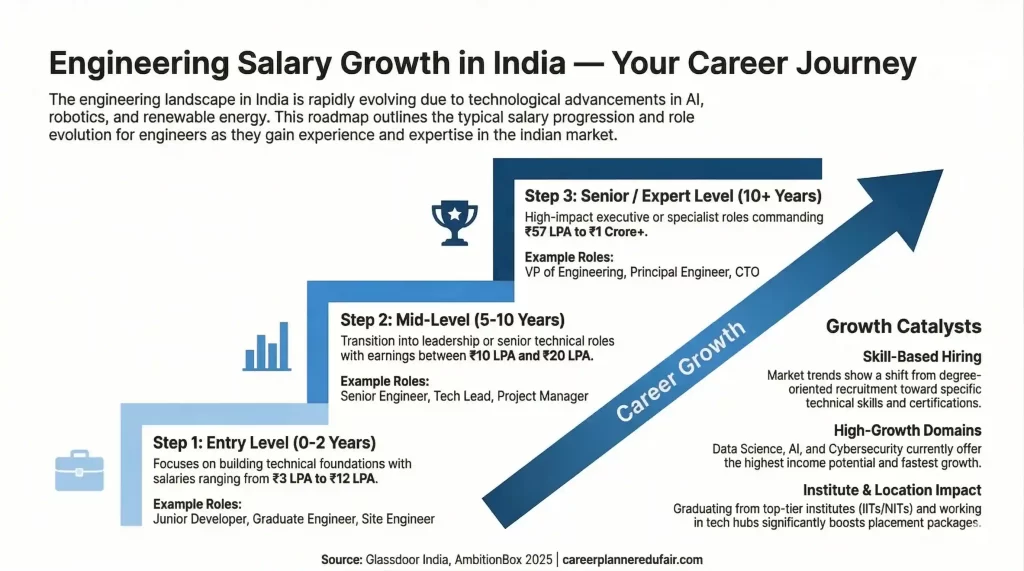
Here’s an overview of the engineering salary in India by experience level:
| Experience Level | Salary Range |
| Entry-level (0-2 years) | INR 3 LPA- INR 12 LPA |
| Mid-level (5–10 years) | INR 10 LPA- INR 20 LPA |
| Senior/Experienced level (more than 10 years) | INR 57 LPA- INR 100 LPA |
Engineering Salary in India: Domain-wise
Engineering is the umbrella term for various disciplines, including civil, mechanical, software, and chemical. While all these domains require engineers to design, build, and maintain efficient, safe, and practical solutions, the salary packages vary significantly.
Let’s explore the engineering salary based on the top 10 domains:
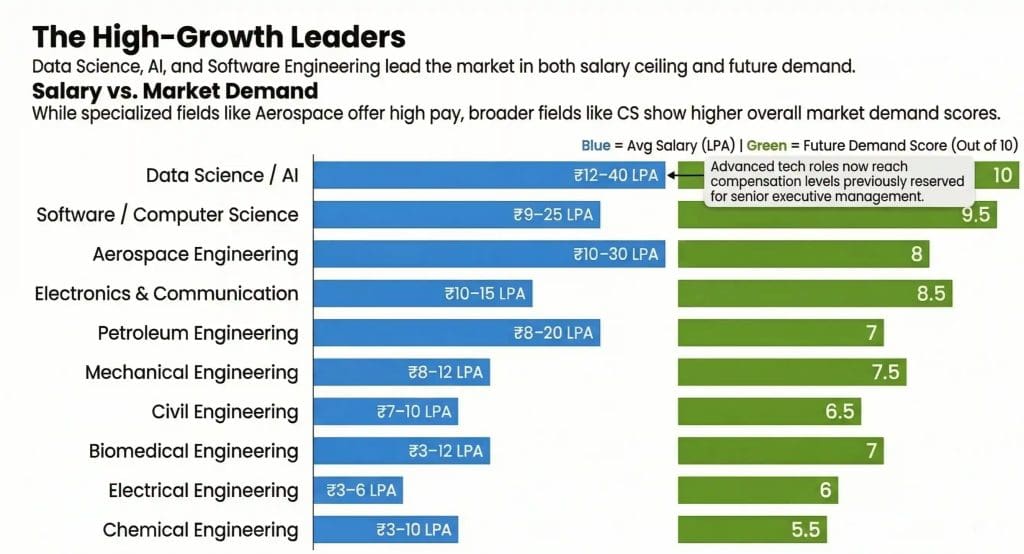
| Engineering Domain | Average Salary |
| Civil Engineering | INR 7 LPA- INR 10 LPA |
| Software / Computer Science | INR 9 LPA- INR 25 LPA |
| Chemical Engineering | INR 3 LPA- INR 1 LPA |
| Electrical Engineering | INR 3 LPA- INR 6 LPA |
| Data Science/Artificial Intelligence (AI) | INR 12 LPA- INR 40 LPA |
| Electronics & Communication | INR 10 LPA- INR 15 LPA |
| Petroleum Engineering | INR 8 LPA- INR 20 LPA |
| Biomedical Engineering | INR 3 LPA- INR 12 LPA |
| Aerospace Engineering | INR 10 LPA- INR 30 LPA |
| Mechanical Engineering | INR 8 LPA- INR 12 LPA |
Factors Influencing Engineering Placement Packages
Knowing your salary, both experience-wise and domain-wise, will help you choose the right career path. While traditional industries like IT and manufacturing continue to hire professionals, emerging fields such as AI and electric vehicles are also creating new job opportunities.
With all these job prospects, there is a significant transformation in India’s engineering placement scene. From degree-oriented recruitment, there has been a noticeable shift towards skill-based hiring. The better your skill set, the more your salary package will be. Moreover, other factors influence engineering placement packages, such as:
Institute reputation: A reputed engineering institute is essential in determining placement packages. Top institutes like the National Institutes of Technology (NITs), the Indian Institutes of Technology (IITs), and the Institute of Technology and Science (BITS Pilani) attract leading companies, offering lucrative salaries.
Specialisation: Some engineering branches are in higher demand or trending in the current job market. For instance, the power of automation across sectors increases the scope of artificial intelligence engineering. It thus automatically drives placement packages for students.
Skills and projects: Students with strong technical skills, like web development or C++, receive better placement opportunities. They can demonstrate their skills through certifications from Google or Amazon Web Services (AWS) that strengthen their credibility.
Internships: Students can gain real-world experience and industry exposure. In fact, many companies provide Pre-Placement Offers (PPOs) to engineering graduates who perform well.
Location: Institutes located in metropolitan cities like Pune, Bengaluru, and Kolkata have better industry connections. As a result, they attract more recruiters, thereby increasing students’ salary packages.
Skills Required to Build a Career in Engineering
To build a successful career in engineering, students should develop technical knowledge, expertise in practical tools, and problem-solving abilities. Modern employers expect engineers to understand both theoretical concepts and work with industry-relevant technologies.
The following are the technical skills and tools engineers use across different domains:
| Technical Skills | Tools/Technologies Used |
| Programming and coding | Python and Java |
| Cloud computing | Excel and Structured Query Language (SQL) |
| Web development | React and Node.js |
| AI and Machine Learning (ML) | PyTorch and TensorFlow |
| Version control | GitHub and GitLab |
Soft Skills for an Engineering Career
Apart from technical expertise, aspiring engineers should focus on professional skills that will help them advance their careers. These skills include:
- Analytical thinking
- Problem-solving abilities
- Time management
- Collaboration
- Project management
Best Institutes for Engineering
India is home to over 250 top-ranked engineering institutes. While most of them are privately owned, the government also runs some of the institutes.
All these institutes provide 4-year or integrated engineering programs in various fields. They include Electronics Engineering, Mechanical Engineering, Civil Engineering, and several other programs.
To understand the scope of engineering, you can check out the following institutes. Along with knowledge and skills in different technical fields, these institutes will also provide placement opportunities. According to the last NDRF 2025 data, India’s top 10 engineering colleges are as follows:
- Indian Institute of Technology Roorkee
- Indian Institute of Technology Hyderabad
- Indian Institute of Technology Guwahati
- National Institute of Technology Tiruchirappalli
- Indian Institute of Technology (Banaras Hindu University) Varanasi
How to Select the Right Engineering Course for the Future?
There has been steady innovation across industries. To harness such innovation, the demand for engineers is at a peak compared to before.
Fields like data science, artificial intelligence, and robotics make the future scope of engineering quite promising. As a result, to gain a complete understanding of these domains, it is essential to find a suitable engineering course.
From aerospace engineering programs to data science and business analytics courses, there is a myriad of engineering programs. However, after 12th grade, many students find it daunting to choose a suitable program. The following are the tips to select the right engineering courses for the future:
Identify Your Interests
Students should identify their interests and passions while choosing an engineering program. If they are interested in understanding the fundamentals of aerodynamics, aerospace engineering can be their program of choice.
Explore Career Opportunities
Once you know your interests, you can check out the career opportunities in engineering. You can go for courses that offer a wide range of career options. For instance, data science and business analytics courses provide career opportunities such as data analyst, data scientist, and business intelligence consultant.
Check for NBA Accreditation
Opt for courses that get NBA-accreditation. It is the main body under the All India Council for Technical Education (AICTE) that evaluates the quality of technical courses.
Research Institutes Thoroughly
Conduct comprehensive research on the institute that is offering the engineering program. IITs and NITs usually have a strong reputation in offering technical courses. Enrolling in such prestigious institutes will also provide better placement opportunities.
How to Build a Successful Career in Engineering?
Engineers play a pivotal role in making the world functional and efficient. Continuous technological advancement is leading students to pursue engineering.
Many students find engineering to be one of the best career options after 12th science. However, the rising competition often makes it difficult for many individuals to advance their careers. To build a successful career in the field of engineering, you can follow certain tips:
Find Inspiration in Industry Leaders
Take inspiration from top industry leaders and jumpstart your career in engineering. You can identify the role model who inspires you and walk along the path.
To master technology, you can follow the lines of prominent figures like Mark Zuckerberg and Steve Jobs. Study their strategies and career paths to understand what sets them apart.
Embrace Teamwork and Collaboration
Engineering fields usually promote teamwork to solve complex problems. To ensure you become a successful engineer, it is imperative to work in teams and engage in group projects. Learn to hone your skills in collaborative effort, and you can unlock the scope of engineering.
Build a Strong Professional Network
Career advancement in engineering requires building a strong professional network. You can connect with people from your field, say data science and explore the best career options after engineering.
Stay Ahead with Continuous Learning
There is an ongoing evolution in the engineering field. New technologies are constantly emerging, driving up demand for engineers. To stay ahead of the curve, you need to adapt to the new methodologies and trends. You can attend technical seminars or enrol in engineering programs to advance your career.
Future Trends in Engineering
Technological advancement and societal demands are making the future scope of engineering quite promising. As we are in 2026, an array of trends is redefining the engineering landscape. As a result, it creates new opportunities for aspiring students.
The following are the trends in engineering that you should know:
Renewable energy engineering
Continuous climate change drives a shift towards renewable energy sources. Since the energy sector is increasingly demanding more professionals to design and build solar installations and hydroelectric dams, it is promoting a sustainable environment.
Robotics engineering
The advancement of automated systems enables the rapid development of transportation systems and medical practices. Robotics engineers create machines and platforms to facilitate repetitive tasks, increasing human potential to perform more complex job roles.
Space technology
The use of space technology is not just limited to designing aircraft and satellites. Engineers are now incorporating AI to go beyond basic connectivity. From designing drones to capture visuals and processing the raw data for analysis, engineers play a crucial role.
Cybersecurity engineering
The dependency of digital systems prioritises cybersecurity. Engineers who specialise in cybersecurity create and maintain network systems to defend software and databases against digital threats. To facilitate these roles, sectors such as e-commerce and banking require cybersecurity professionals.
Engineering Scope After 12th
The continuous demand for professionals to build and maintain efficient systems makes engineering one of the best career options after 12th science. The multidisciplinary field encompasses branches such as computer science, mechanical engineering, civil engineering, and more.
All these branches provide strong career opportunities and growth potential, depending on the interests and career goals.
The popular career options across different engineering branches include:
- Computer Science Engineering: Software Developer, Database Administrator, and Computer Hardware Engineer
- Civil Engineering: Urban Planner, Structural Engineer, and Transport Planner
- Mechanical Engineering: Nuclear Engineer, Design Engineer, and Automotive Engineer
- Chemical Engineering: Chemical Engineer, Colour Technologist, and Biotechnologist
- Petroleum Engineering: Reservoir Engineer, Drilling Engineer, and Production Engineer
- Information Security: Cybersecurity Engineer, Malware Analyst, and Security Architect
Build an Engineering Career with Guidance from a Career Planner
The continuous demand for infrastructural development and production of systems drives the scope of engineering in 2026. As long as the demand exists, engineers will play a significant role in making human lives easier and better.
Whether you want to build transportation systems or support new technologies, the engineering discipline offers a range of career options. Before exploring different career opportunities, you need to have theoretical knowledge and practical expertise in engineering.
To gain such knowledge, India boasts a significant number of government and private engineering institutes, with a B.E or B. With a tech course from IITs or NITs, you can make a way into different branches of engineering.
Having specialised knowledge in civil, mechanical, or chemical engineering can also help you find opportunities in industries like healthcare, manufacturing, and fintech.
If you are still unsure about choosing a career path in engineering, then Career Planner is here to assist you.
We organise the biggest educational fair in the country to connect students, top institutes, and recruiters.
Our platform helps students understand their interests and career goals, and aligns courses that will advance their career paths. By connecting with industry experts, we help students navigate their engineering careers.
Take our guidance and make a steady engineering career that pays well.
Frequently Asked Questions
Which engineering fields are growing the fastest?
Engineering is one of the fastest-growing disciplines in the country. Various fields in the domain have rewarding career options. They include Machine Learning, Data Science, Artificial Intelligence and Robotics.
Which engineering streams have strong prospects?
The prospects after an engineering degree are quite promising. Streams like Computer Science, Cybersecurity, and IT can provide a myriad of opportunities to start your career.
Which engineering fields have the best income potential?
Most individuals choose engineering after 12th science because it offers a competitive salary. Fields like Systems Engineering, Biomedical Engineering, Environmental Engineering, and Chemical Engineering can offer the highest income potential.
What type of engineering is ideal for girls?
Any type of engineering can be ideal for girls depending on their interests and skills. If someone has extensive knowledge of computer hardware and software, they can pursue a career in Computer Science.
What is the scope of engineering abroad?
There are huge career options in engineering abroad. From high salaries to access to advanced technologies, there is a great future when you start a career in engineering on an international level.
How many years does it take to finish engineering?
A standard undergraduate engineering degree program takes 4 years to finish. It includes the B.Tech. or B.E. programs. However, when you enrol for an integrated program like M.Tech, it can take 5 years to complete.
Which exams are required for engineering admission?
To pursue admission to engineering programs, students take national exams such as the Joint Entrance Examination (JEE). The exam takes place at two levels: Main and Advanced. While JEE Main is a qualifying test for admission to IITs and NITs, JEE Advanced is a more difficult exam for admission to the Indian Institutes of Science Education and Research (IISERs).
What are the top government job exams for engineering graduates?
Engineering graduates can seek government jobs through various exams. These include the GATE exam (for public sector undertakings), the UPSC Group A exam (for officer ranks in central government departments), and ISRO/DRDO exams (for scientific research positions).
How much money is required to complete an engineering?
The cost of completing the four-year engineering program ranges from INR 5 Lakhs to INR 15 Lakhs or more. Usually, the cost depends on the institutions you’re enrolling on. For government and prestigious institutes like NITs and IITs, you spend about INR 5-8 Lakh. However, private colleges like BITS and VIT can cost around INR 10-15 Lakhs to complete an engineering degree.