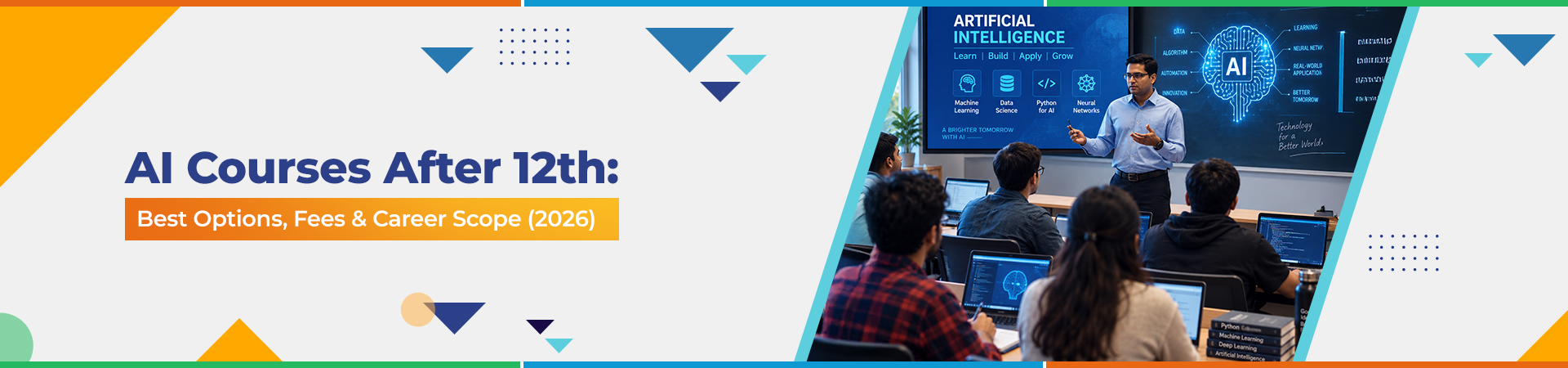
Artificial Intelligence is no longer just a futuristic idea. It is already being used across healthcare, finance, automotive, education, entertainment, and many other industries.
As AI becomes a bigger part of everyday business and technology, it is also creating new career opportunities for students completing Class 12.
Exploring AI courses after 12th can be a practical way to enter this growing field. Depending on their academic background and career interests, students can choose from courses covering artificial intelligence, machine learning, data science, computer applications, and related areas.
However, choosing an AI course is not simply about picking the most popular program. Before deciding, consider eligibility, course duration, fees, mathematics requirements, technical depth, and career opportunities.
This covers the best AI course options after Class 12, along with their eligibility, fees, entrance requirements, career scope, and potential job opportunities.
AI Courses After 12th: At a Glance
- Primary Pathways: Choose between highly technical engineering degrees (B.Tech/B.Sc), practical computer applications (BCA), business tracks (BBA), or rapid vocational diplomas.
- Mathematics Requirement: Class 12 Maths is mandatory for B.Tech engineering lines, but is optional for many BCA, BBA, and short-term certification courses.
- Financial Investment: Total course fees range from ₹20,000 to ₹6 Lakhs in public government institutions and ₹1 Lakh to ₹18 Lakhs at private universities.
Why AI Is a Serious Career Option After 12?
AI is a serious career option after Class 12 because its use is expanding across industries and creating demand for people with relevant technical and practical skills.
Students can build careers in areas such as machine learning, data science, software development, automation, and AI applications across different sectors.
What Kind of AI Course Are You Actually Looking For?
Your learning path for artificial intelligence after 12th depends on your career goals, the time you can invest, and how deeply you want to study the field. You can choose a full degree for comprehensive learning or take a diploma or certificate to build specific skills in a shorter time.
| Course Type | What You Learn? | Typical Duration | Suitable For |
|---|---|---|---|
| Degree | Covers AI along with subjects such as programming, data, machine learning, and computer science | 3-4 years | Students who want to build a long-term career in AI or related fields |
| Diploma | Focuses on practical AI skills and selected technical areas | 6 months-2 years | Students who want focused training without committing to a full degree |
| Certificate | Teaches a specific AI skill, technology, or application | Few weeks-12 months | Students who want to learn a particular skill or get introduced to AI |
Am I Eligible for AI Courses After 12th?
Yes, students who have completed Class 12 can apply for several AI-related undergraduate, diploma, and certificate courses. However, the exact requirements vary by programme, with technical degrees generally having stricter subject and Mathematics requirements.
- Class 12 qualification: You generally need to pass Class 12 or an equivalent examination from a recognised board.
- Required subjects: B.Tech (Bachelor of Technology) AI programmes usually require Physics and Mathematics, often along with Chemistry or another approved subject.
- Mathematics: Many B.Sc (Bachelor of Science) and BCA (Bachelor of Computer Application) programs with AI specialisations require Mathematics or an equivalent subject in Class 12, although some programmes accept students from broader backgrounds.
- Minimum marks: Colleges may set their own percentage requirements, commonly ranging from 45% to 60% or higher, depending on the course and institution.
- Stream requirements: Science students can access most technical AI pathways, while Commerce and Arts students can also find eligible BCA, data, and AI programmes, depending on the institution.
- Entrance exams: Some programmes require JEE (Joint Entrance Exam) Main, CUET (Common University Entrance Test), a university entrance test, or another specified admission process, while others offer merit-based admission.
Is Maths Compulsory for AI Courses?
No, Mathematics is not compulsory for every AI course after Class 12. Many technical programs, especially B.Tech courses in AI and related engineering fields, require Mathematics in Class 12.
However, students looking for AI courses after 12th without maths can consider options such as:
- BCA programs with AI or related specialisations, where the college does not require Mathematics.
- Diploma courses in AI and Machine Learning with flexible subject requirements.
- Certificate courses in AI, machine learning, or data analytics that focus on practical skills.
Stream-Wise Pathways: Which AI Courses Can You Choose?
Your Class 12 stream can affect the AI programmes you can apply for, particularly when Mathematics or specific science subjects are required.
However, you can pursue AI courses after 12th in engineering, computer applications, data, business, and other areas.
AI Courses After 12th (PCM/Science)
With PCM (Physics, Chemistry, and Maths), you can choose from several technical programs that provide a strong foundation in AI, programming, and related technologies.
- B.Tech in Artificial Intelligence & Machine Learning: Covers programming, machine learning, algorithms, and other core areas of AI.
- B.Tech in Artificial Intelligence & Data Science: Brings together AI, data analysis, statistics, and computing.
- B.Tech in Computer Science with AI/ML specialisation: Gives you a broader computer science education with additional focus on AI and machine learning.
- B.Tech in Robotics & Artificial Intelligence: A good fit if you are interested in robotics, automation, intelligent machines, and AI.
- B.Sc in Artificial Intelligence or Data Science: Offers a science-based route into AI and data without following the traditional B.Tech pathway.
AI Courses After 12th (PCB)
PCB (Physics, Chemistry, and Biology) students may not meet the requirements for every AI engineering programme. Still, they can look at courses that bring AI and computing into healthcare, biology, and related fields.
- B.Sc in Bioinformatics: Combines biology with computing and data analysis, with applications in areas such as biotechnology and life sciences.
- B.Tech in Bioinformatics with AI specialisation: Combines biological sciences with programming, data, and AI applications where offered by the institution.
- B.Sc in Data Science: Some colleges accept PCB students, so check individual eligibility requirements.
- BCA with an AI specialisation: Certain universities accept students from different streams for BCA and related AI programmes.
- AI and healthcare certifications: Short courses can introduce you to AI tools and applications used in healthcare and life sciences.
AI Courses After 12th Commerce
Commerce students can take a less engineering-focused route by combining AI with business, finance, analytics, and computer applications.
- BCA with an Artificial Intelligence specialisation: Covers computer applications and can provide a foundation for moving into AI-related work.
- BCA in Artificial Intelligence & Data Analytics: Combines programming and computer applications with data and AI concepts.
- B.Com with Business Analytics or an AI-related specialisation: Useful for students who want to apply data and AI concepts in business settings.
- BBA with Data Analytics: Connects business studies with data-driven decision-making and analytical skills.
- AI and Business Analytics certifications: Short-term courses can help you develop specific AI or analytics skills alongside a commerce background.
AI Courses After 12th Arts
Arts students can also build AI-related skills, particularly through computer applications, design, digital technology, and interdisciplinary programmes.
- BCA with an Artificial Intelligence specialisation: Covers computer applications with a focus on AI.
- BCA with AI/ML specialisation: Introduces programming, AI, and machine learning.
- BA in Digital Humanities: Combines humanities with digital technologies.
- B.Des in UX/UI Design: Focuses on digital design and user experience.
- AI and technology certifications: Builds practical skills in AI tools, generative AI, or programming.
AI Course Comparison: B.Tech vs B.Sc vs BCA vs BBA vs Diploma vs Certificate
Artificial intelligence courses after 12th vary in study level, time commitment, eligibility, and the careers they can lead to. Fees can also vary widely between colleges, so treat the figures below as general estimates.
| Course | Duration | Eligibility | Maths | Approx. Fees | Best For |
|---|---|---|---|---|---|
| B.Tech in AI/ML | 4 years | Class 12 with PCM; entrance requirements may apply | Usually required | ₹4-18 lakh | Students who want a technical AI or engineering career |
| B.Sc. in AI/Data Science | 3 years | Class 12; requirements depend on the college | Usually preferred/required | ₹1-5 lakh | Students interested in AI, data, and analytics |
| BCA with AI/ML | 3-4 years | Class 12; some colleges accept students from different streams | Varies | ₹1.5-6 lakh | Students who want to enter AI through computer applications |
| BBA with AI/Business Analytics | 3-4 years | Class 12 from any stream at many institutions | Usually not required | ₹3-9 lakh | Students interested in AI, business, and analytics |
| Diploma in AI/ML | 1-2 years | Class 12; requirements vary | Varies | ₹50,000-₹1.5 lakh | Students looking for shorter, focused AI training |
| AI Certificate | 3-12 months | Usually Class 12 or equivalent | Usually not required | ₹5,000-₹1.5 lakh | Students who want to learn a specific AI skill in less time |
Which Entrance Exams Do You Need?
The entrance exam depends on the AI course and the college you choose. Some colleges use national or state-level exam scores, while others have their own admission tests.
Some of the common exams you may come across are:
- JEE Main (Joint Entrance Examination Main): Commonly used for admission to B.Tech and other engineering programmes.
- CUET (Common University Entrance Test): Used by many participating universities for undergraduate admissions.
- WBJEE (West Bengal Joint Entrance Examinations): Used for engineering and technology admissions in participating colleges across West Bengal.
- University-Specific Tests: Some colleges and universities conduct their own entrance exams for AI, BCA, B.Sc., and related courses.
How Much Do AI Courses Cost After 12th?
The cost of an AI course ranges between ₹1.5 lakh and ₹18 Lakh for a degree program. Diploma courses comparatively cost less, depending on the programme, college, and whether you study at a government or private institution.
AI course fees also differ between government and private colleges. The courses are generally more affordable in government institutions, while private colleges can have higher fees.
| Course Type | Government Colleges (Approx range) | Private Colleges (Approx range) |
|---|---|---|
| B.Tech in AI/ML | ₹2-₹6 lakh | ₹8-₹18 lakh |
| BCA with AI/ML | ₹50,000-₹3 lakh | ₹1-5 lakh |
| Diploma in AI/ML | ₹20,000-₹1 lakh | ₹50,000-₹1.5 lakh |
| AI Certificate Courses | ₹2,000-₹50,000 | ₹5,000-₹1.5 lakh |
B.Tech AI vs BCA AI vs B.Sc AI — Which Is Better?
No single course is right for every student. Your choice should depend on your Class 12 background, interest in maths and programming, and the kind of AI career you want to pursue.
B.Tech in AI
Choose B.Tech if you want a deeper technical and engineering-based education in AI. You will study programming, algorithms, machine learning, data structures, and other core computing subjects.
BCA with AI
BCA with AI gives you a computer applications background while introducing you to artificial intelligence and related technologies. It is a practical option for students who want to enter the AI field without choosing a traditional engineering degree.
B.Sc in AI
B.Sc in AI takes a more science- and data-focused approach to the subject. Depending on the college, you may study AI alongside data science, statistics, programming, and machine learning.
Career Opportunities and Job Roles After an AI Course
Students who choose artificial intelligence courses after 12th can explore careers across technology, data, automation, and software development. The roles you can target will depend on your course, technical skills, and experience.
Here are some common career options and the job roles associated with them:
- Data Scientist: Studies data to find patterns, answer questions, and support better decisions.
- Software Developer: Builds and maintains software applications, including AI-powered tools and systems.
- AI Engineer: Develops and implements AI systems for tasks such as automation, prediction, and language processing.
- Robotics and Automation Specialist: Works on robots and automated systems that use AI to perform tasks with less human input.
- ML Engineer: Builds and improves machine learning models that learn from data and make predictions.
What Salary Can You Expect After an AI Course?
The average salary after an AI course is ₹5 LPA. Based on experience and career options, the salary range may vary.
The table below highlights the salary of an ML Engineer with different experience levels:
| Experience Level | Average Salary Range |
|---|---|
| Junior ML Engineer | ₹5L-₹12L/yr |
| Senior ML Engineer | ₹13-₹20L/yr |
| ML Engineer Manager | ₹32-₹34L/yr |
*Source: Glassdoor
Can You Learn AI Without Coding?
Yes, you can learn the basics of AI without knowing how to code. Many beginner courses focus on AI tools, concepts, applications, and prompt writing rather than programming.
However, if you want to build AI systems or work in areas such as machine learning and AI development, learning languages like Python will be important. You can start without coding and gradually develop your programming skills.
Your Roadmap: From Class 12 to Your First AI Role
Starting an AI career after Class 12 takes time, so build your skills step by step. The course you choose is only the starting point; projects, practice, and real-world experience matter too.
Here’s a practical roadmap to get started:
- Choose a Course: Pick a degree, diploma, or certificate that fits your interests and eligibility.
- Learn the Basics: Start with programming, maths, statistics, and basic AI concepts.
- Build Technical Skills: Learn Python, AI tools, machine learning libraries, and data-handling tools.
- Make Small Projects: Use what you learn to create simple AI or data projects.
- Build Your Portfolio: Keep your best projects, certifications, and GitHub work in one place.
- Get Some Experience: Apply for internships or take on small freelance and practical projects.
- Start Applying: Look for entry-level roles that match your skills, such as data analyst, AI developer, or ML engineer.
Plan Your AI Career with Career Planner
Choosing from different AI courses after 12th can be quite overwhelming. But when the course aligns with your interests, subjects, and long-term career plans it becomes easier to choose a path that fits you.
Take time to compare your options, check eligibility and fees, and understand where each course can lead.
At Career Planner, we organise educational fairs to help students understand the courses that would set their careers in AI. We also highlight the scope of AI engineering to explore a myriad of career options in related fields.
Join our educational event to turn your interest in AI into a full-fledged career.
FAQs
Can I study AI after 12th?
Yes, you can study AI after Class 12 through degree, diploma, and certificate programmes. Options include B.Tech in AI/ML, B.Sc in AI or Data Science, BCA with AI specialisations, and shorter AI courses. Your eligibility will depend on the subjects you studied and the college you choose.
Which stream is required for AI courses?
Science with Physics and Mathematics gives you the widest choice, especially for B.Tech AI and engineering programmes. However, students from Commerce and Arts can also find AI-related options through BCA, BBA, data analytics, and certificate programmes, depending on the institution’s eligibility rules.
Can I pursue AI after 12th without Maths?
Yes, some AI-related courses accept students who did not study Mathematics in Class 12. BCA, diploma, and certificate programmes may offer more flexible eligibility, although requirements vary. Most B.Tech AI and engineering programmes do require Mathematics, so always check the specific college criteria before applying.
Can Commerce or Arts students pursue AI?
Yes, Commerce and Arts students can enter the AI field through suitable courses. Some institutions offer BCA with AI, BBA with Business Analytics, data-related programmes, and AI certifications. The available choices depend on the college, course requirements, and subjects studied in Class 12.
What is the average fee for AI courses after 12th?
AI course fees vary widely by programme and institution. A B.Tech may cost around ₹8-₹18 lakh (private colleges), while BCA programs can be around ₹50,000-₹3 lakh (government colleges). Diploma and certificate courses are usually cheaper, but fees vary by college.
Is AI a good career choice in India?
Yes, AI can be a strong career choice in India as businesses across technology, finance, healthcare, manufacturing, and other sectors increasingly use AI. Students can build careers in areas such as machine learning, data science, software development, automation, and AI engineering.
Is AI a high-paid job?
AI can be a well-paying career, but salary depends on your role, skills, experience, and employer. Entry-level professionals may start with moderate salaries, while experienced AI and machine learning professionals can earn significantly more, particularly in specialised technical roles.
How do I start my AI career?
Start by choosing an AI-related course that matches your interests and eligibility. Then build programming and data skills, learn tools such as Python, work on practical projects, gain internship experience, and create a portfolio before applying for suitable entry-level AI or data roles.