Does creating engaging content, storytelling, news, or social media trends interest you? Perhaps you like expressing ideas through writing or visuals and wonder: how to turn that passion into a career?
If that sounds like you, consider exploring mass communication courses after 12th.
In today’s digital world, mass communication has become one of the most sought-after career paths. The rapid growth of digital platforms, journalism, and public relations is driving the demand for skilled professionals.
Businesses and organisations need confident individuals who can communicate well and connect with audiences. It helps them express their opinions and brings a change to society.
Such a responsibility comes with utmost value and respect. Besides the creative satisfaction, mass communication also offers attractive salary prospects with experience and specialisation.
If you’re passionate about making an impact in society through media, then you’ve come to the right place.
This blog will discuss what mass communication is and its best courses after 12th in India that will help you find promising careers in the media industry. Furthermore, it will explore the eligibility criteria for the courses, top colleges, and salary prospects to help you make an informed decision.
Key Takeaways
A career in mass communication highlights immense opportunities. To unlock those opportunities, you need to find the right course and understand its core aspects, which include:
- Mass communication goes beyond journalism. Its essential branches are public relations, digital media, filmmaking, advertising, and more.
- CUET, IPU CET, or GMCET are the crucial entrance exams for mass communication students after 12th.
- Students from any stream (Arts, Commerce, Science) can pursue mass communication.
- Depending on your career goals, you can choose from a degree, a diploma, or certificates.
- Mass communication offers diverse career options, including radio jockeys, advertisers, news presenters, and video producers.
- The average salary of a journalist is around ₹2.5 – ₹4 LPA.
What is Mass Communication?
Mass communication is the process of sharing information with large audiences through newspapers, TV, radio, digital media, social media, advertising, and films.
Mass communication/mass media is a dynamic field that involves sharing information with large audiences through various media. It involves newspapers, radio, television (TV), social media, and digital platforms. In simple terms, mass communication is the means by which messages, ideas, and stories reach people on a wide scale.
Many students believe that mass communication is only about journalism. But it’s just a part of the field. Mass communication typically encompasses content creation, public relations, advertising, and video production.
Why is Mass Communication More Than Journalism?
In the new era, as people consume content daily through news, ads, podcasts, or reels, they are already engaging with mass communication. It thus makes it more than just journalism, which involves sending information through news reporting and writing.
It takes a bit of creative thinking and an understanding of the audience to deliver the information to them. With mass communication, you can develop strong communication and creative skills to create and share content.
It will also offer hands-on experience in areas like video editing, news writing, and storytelling, making it a popular career choice after 12th.
Key Branches of Mass Communication
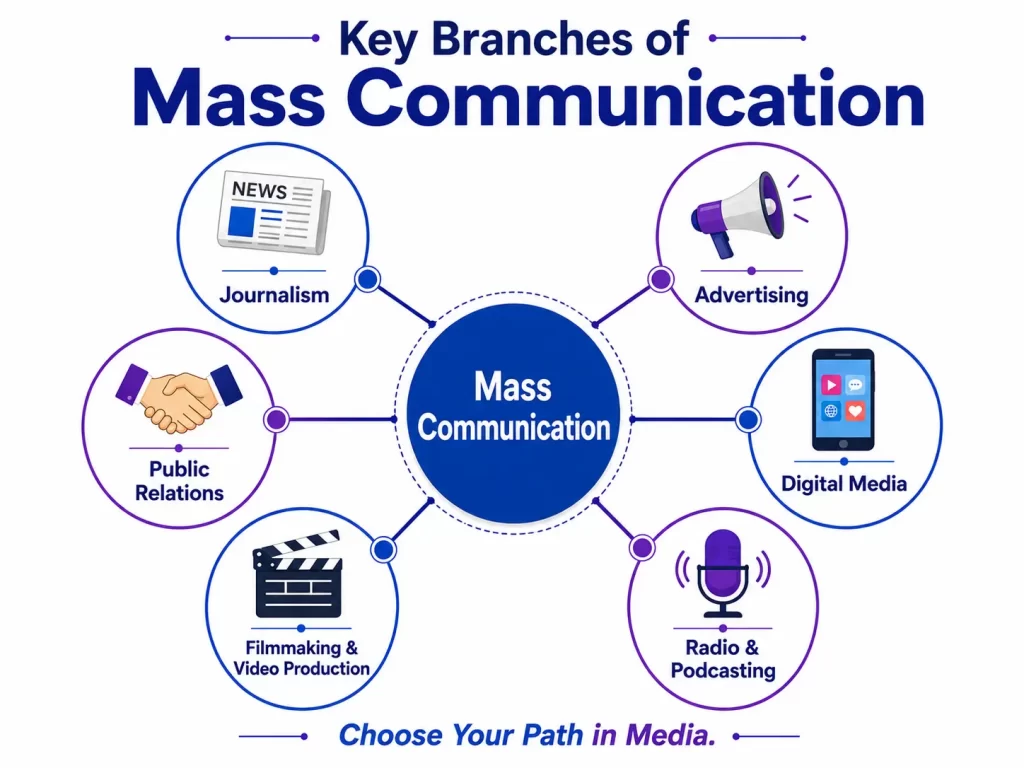
Mass communication is a multi-disciplinary field that combines different branches. Each branch focuses on a unique way of delivering content and connecting with people.
The key branches of mass communication include:
- Journalism is a branch of mass communication that focuses on reporting news and writing articles about real-life events. Students can pursue journalism after 12th in print, TV, and digital platforms/websites.
- Advertising: It combines creativity and marketing strategies to create campaigns. These campaigns help promote the products and services of various organisations.
- Public Relations (PR): The branch ensures managing a brand’s image and communication with the public/audiences. PR professionals handle media relations, press releases, and events.
- Digital Media: It is one of the fastest-growing areas of the media industry today. Digital media covers content creation for online platforms such as social media, blogs, and websites.
- Filmmaking & Video Production: Focuses on creating visual content like films, documentaries, and web series. A person who is passionate about this branch can also find roles in scripting, shooting, and editing.
- Radio & Podcasting: It involves audio content such as radio shows, podcasts, and voiceovers.
How the Field Has Evolved in 2025–26?
The evolution of digital media and technology has led to a rapid shift in mass communication. Earlier, what was witnessed as one-way broadcasting is now transforming into a decentralised platform.
It offers a new space for content creation, with short-form videos, podcasts, and live streaming. Furthermore, mass communication is now moving towards data-driven content. In such a scenario, media professionals are now using analytics to understand what audiences are looking for.
By determining the idea, they can create more engaging content that will help shape opinions and ideas. For students, it increases the likelihood of building a successful career in the media sector.
Eligibility Criteria for Mass Communication Courses After 12th
After understanding what mass communication is, the next step is to check whether you’re eligible to pursue it. Checking eligibility to pursue mass media courses after 12th is quite simple.
Here are certain things you have to keep in mind regarding mass communication eligibility criteria:
Can students from any stream apply?
Yes, students from any stream, be it Arts, Science, or Commerce, can apply for mass communication courses. It offers an open field for students with different academic backgrounds.
Minimum percentage requirements
After passing the class 12 exam in any stream, students will require a minimum of 50-55% marks to study a course in mass communication. It, however, depends on the cut-offs set by the government and private institutes.
In some cases, top institutes also select students through entrance exams. It gives them more opportunities to build careers in top fields like PR, journalism, and digital media, even with average class 12 scores.
Age limit, if any
Usually, there is no strict limit for pursuing a mass communication course. However, some universities or entrance exams may set a standard age range between 17 and 25 years. It is better to follow the institute guidelines for age or other criteria before applying.
Overall, a student who has passed class 12 and is passionate about media studies can have a chance in mass communication.
Skills Required for Mass Communication Courses
Once you learn that you’re eligible for mass communication, you will start looking for a course to gain in-depth knowledge about its various fields. However, you must be equipped with certain soft and technical skills for the discipline.
The core skills for mass communication programmes include:
- Strong communication: As the name suggests, students should express their ideas clearly through speaking or writing.
- Creativity and innovation: Fresh ideas can help make a career in mass communication. You need to be creative in areas like advertising, social media, or filmmaking to reach and connect with the audience.
- Writing: To pursue a journalism course after 12th or enter digital media, you need strong writing skills. It includes news writing, scriptwriting, or content writing for print or digital platforms.
- Curiosity and awareness: You should be updated with current trends, events, and audience behaviour. Moreover, you should sharpen your curious mind to ask the right questions and create relevant content.
- Technical skills: Mass communication professionals should have technical skills to gain a competitive advantage in delivering information. Basic knowledge of social media tools and video editing can unlock opportunities for roles such as social media strategist and video editor.
- Adaptability: The media industry is changing rapidly. New trends keep emerging. It is therefore essential to learn and adapt to new formats, tools, and technologies to stay relevant.
Types of Mass Communication Courses After 12th
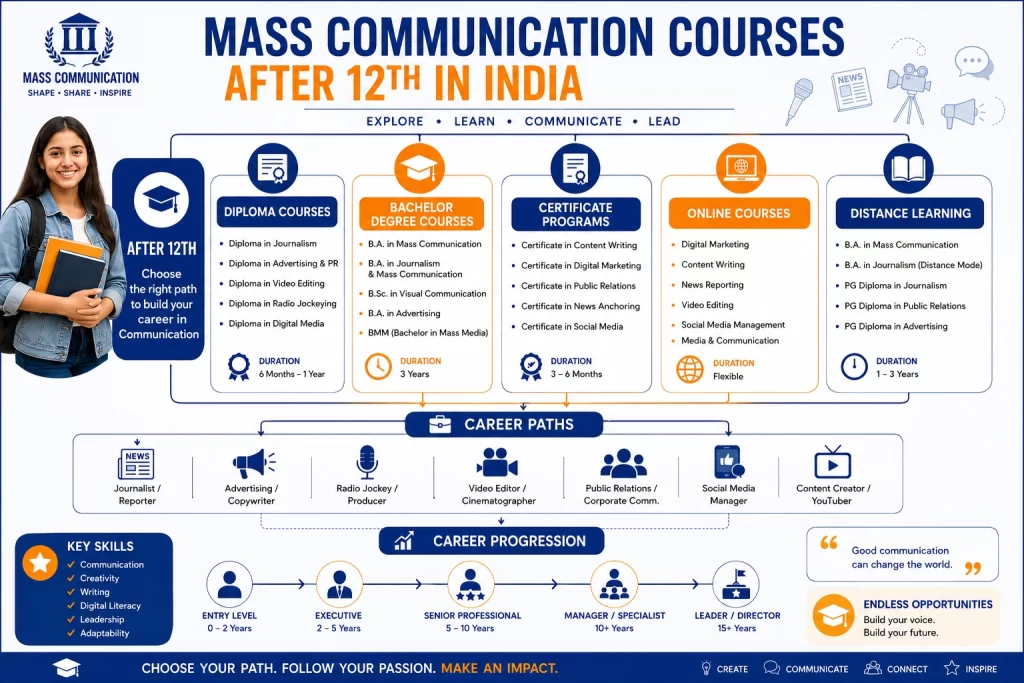
Once you know the required skills, it’s time to understand the different course options in mass communication. Depending on their career goals, students can choose a suitable option. They can also consider their time and budget when deciding on journalism and mass communication courses after 12th.
Diploma courses
These courses are ideal for students who want to enter the employment sector quickly. It covers areas such as PR, advertising, journalism, and video production, where students can gain early hands-on experience.
Some popular diploma courses include the Diploma in Mass Communication and the Diploma in Advertising and Public Relations, which last 1 to 2 years.
Undergraduate degrees
After 12th grade, undergraduate degrees are the most popular options for students. Courses like the Bachelor of Arts (BA) in Mass Communication or the Bachelor of Journalism and Mass Communication (BJMC) offer a comprehensive understanding of the field in 3 years.
These programs will give you in-depth knowledge of subjects such as corporate communication, news writing, and media law. Along with theory, the courses will provide industry exposure through practical assignments and internships.
Certificate courses
Certificate courses are short-term, typically lasting 6 months to 1 year. Beginners who want to learn specific skills such as social media management, content writing, and video production can pursue these courses.
Some of the best short-term courses after 12th in mass communication are the Advanced Certificate Program in Advertising Management & Public Relations and Certificate Course in Radio Programming. These programmes are also effective for professionals who are willing to upgrade their skills.
Online vs. Offline vs. Distance Mode
The courses from degree to certification have online, offline, and distance modes. While offline mode provides a more interactive learning experience, online and distance modes help students to understand mass media concepts at their own pace.
The following will highlight the comparison between online, offline, and distance modes for mass communication programmes:
| Mode | Key Features | Best For |
| Offline | Classroom learning Direct interaction Better doubt-clearing scope Better networking opportunities | Students who learn through interactive sessions |
| Online | Accessible Flexible learning | Students who require flexibility |
| Distance | Minimal attendance Affordable fees Pre-recorded teachings | Working professionals or students from remote areas |
Top Entrance Exams for Mass Communication Courses in India (2026)
After exploring the course types, you may want to know how to get into top colleges to study mass media. While many universities give direct admission based on class 12 marks, the best ones usually conduct entrance exams.
These entrance exams assess your general awareness, communication skills, and media aptitude. The top entrance exams for courses in mass media after 12th are:
CUET UG
It is the Common University Entrance Test for undergraduate-level students. After the 12th exam, CUET assess language skills, reasoning ability, and general knowledge.
Passing the CUET can open doors to government colleges such as Jamia Millia Islamia University, Delhi University (DU), and Banaras Hindu University (BHU).
GMCET
It stands for the Global Media Common Entrance Test, which focuses on areas like communication and media awareness.
It is among the journalism course entrance tests that provide admission for courses like BJMC. The colleges that hold GMCET are Chandigarh University and Amity University.
IPU CET
Guru Gobind Singh Indraprastha University conducts the Indraprastha University Common Entrance Test (IPU CET). The exam allows students to enrol in BJMC after 12th, provided they demonstrate proficiency in English, general knowledge, and media aptitude.
DUET and ACJ entrance exams
These are internal entrance exams of top universities/colleges. The DUET is the Delhi University Entrance Test for specific media-related programmes at Delhi University.
The entrance exam for ACJ (Asian College of Journalism) is for students who want to undergo in-depth journalism training. These exams vary in terms of patterns and difficulty level. So, it is crucial to review the syllabus and prepare accordingly.
Best Colleges for Mass Communication Courses after 12th in India
Now that you know about the entrance exams, the next step is to enrol in media courses after 12th at a good institute. A college plays a huge role in shaping your exposure and career opportunities in the mass communication field.
While some colleges are government-funded, others are private institutions that provide strong industry connections. Depending on your budget and the courses you choose, you can select colleges for mass communication.
Top Government Colleges
Students seeking a strong academic foundation in mass media can explore government colleges. Top colleges also offer strong placement opportunities and experienced faculty. Some of the best government colleges for mass media courses are:
- University of Calcutta
- Jawaharlal University (JNU)
- Delhi University (DU)
- Jamia Millia Islamia (JMI)
- Banaras Hindu University (BHU)
Top Private Institutes
Students often choose private colleges for mass communication because of modern facilities, workshops, and internships. These efforts help students gain hands-on experience in news reporting, filmmaking, advertising and more.
Top private colleges for mass communication programmes include:
- Symbiosis Institute of Media and Communication (SIMC)
- AAFT (Asian Academy of Film and Television)
- Amity University
- Asian College of Journalism (ACJ)
- Christ University
Best Colleges by City
Mass communication has colleges spread across major cities like Chennai, Bangalore, Kolkata, Delhi, and Mumbai. Let’s see some of the popular colleges for mass media programmes by cities:
| City | College |
| Kolkata | University of Calcutta, St. Paul’s Cathedral Mission College |
| Bangalore | Christ University, Jain University |
| Mumbai | St. Xavier’s College, Mumbai University |
| Chennai | Loyola College, Asian College of Journalism |
| Delhi | Delhi University, Jamia Millia Islamia, IP University |
Fees for Mass Media Courses after 12th: Government vs. Private
After selecting the suitable college for your mass communication programme, it is essential to know the cost. The fees usually depend on the course type, mode of study, and college.
Government colleges are usually more affordable. In contrast, private colleges may cost more but provide better infrastructure and industry exposure.
Students or working professionals also choose the online/distance mode for self-paced learning. Institutes like the Indira Gandhi National Open University (IGNOU) offer journalism and mass communication courses at more affordable rates than regular colleges.
Here is a simple breakdown of the fee structure for mass communication programmes at government and private institutes after 12th.
| Course Type | Government Colleges | Private Institutes |
| Certificate Courses | ₹10,000 – ₹50,000 | ₹30,000 – ₹1,00,000 |
| Diploma Courses | ₹20,000 – ₹1,00,000 | ₹50,000 – ₹2,50,000 |
| Undergraduate Degree | ₹30,000 – ₹1,50,000 | ₹2,00,000 – ₹6,00,000+ |
| Online/Distance Mode | ₹10,000 – ₹50,000 | ₹20,000 – ₹1,50,000 |
Scholarships and Financial Aid
For many students, studying at a good college can be expensive even when it is government-funded. In such cases, they look for scholarships and other forms of financial aid. The good news is that India has several scholarship programs that help students secure places to study mass media.
Some of the scholarships and financial aid include:
- National Scholarship Portal (NSP): It is a platform that provides scholarships to students with good academic records and family incomes below INR 2.5 LPA.
- Merit-based scholarships: Many private universities provide fee waivers for top academic achievers. Certain journalism grants and national programmes also support the financial needs of mass communication students.
- Need-based scholarships: These scholarships help students from the economically weaker sections. Some of the programmes include the Tata Capital Pankh Scholarship, which provides 80% of tuition fees and the Danish Siddiqui Journalism Scholarship for post-graduate students.
Career Options in Mass Communication Courses
Once you learn about the course fees, you may ask: what career can you build in the field of communication?
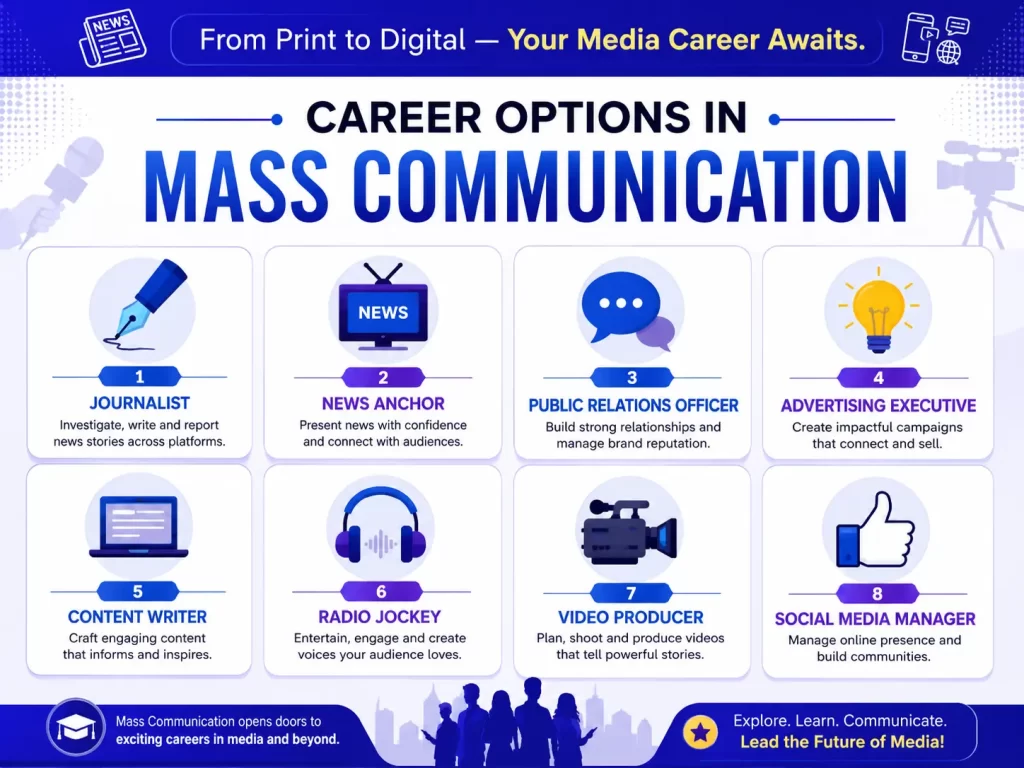
Comprising numerous branches, mass communication offers multiple opportunities. From traditional journalism to new-age podcasts, there are various roles you can play in mass communication.
Each role comes with a set of skills and experience. It will help you build a stable and successful career in the long run.
Traditional Careers in Mass Communication
Students who want to deliver information to large audiences often choose careers as journalists, advertising executives, or radio jockeys. The roles offer some of the best career options after 12th. They disseminate information through print, PR, and broadcast.
Let’s see the traditional careers in mass communication:
| Career Role | Key Responsibilities |
| Journalist | Research news Write reports Conduct interviews |
| News Anchor | Present news Collaboration Breaking news coverage |
| Public Relations Officer | Manage brand image Write press releases Handle media communication |
| Advertising Executive | Plan and execute ad campaigns for brands Setting campaign budgets |
| Radio Jockey (RJ) | Host radio shows Manage audio content Engage listeners |
Top Specialisations Within Mass Communication
Once you gain clarity in mass communication as a whole, it becomes easy to choose a specialisation. Be it digital media, journalism, or advertising, each specialisation provides promising career paths.
| Specialisation | Career Paths |
| Advertising | Copywriter Art Director Creative Director |
| Journalism | News presenter News reporter Photojournalist |
| Public Relations | PR specialist Digital specialist Content writer |
| Digital media | Video producer Podcast producer Digital marketing executive |
| Film & Video Production | Scriptwriter Cinematographer Post-production supervisor |
Salary After Mass Communication Courses
Now that you know the different career options, it’s time to learn about their salaries. Mass communication, like any other profession, offers lucrative salaries depending on experience and role.
Salary Comparison by Role
Students can play various roles in the mass media. By choosing a specialisation, they learn and upgrade their skills to increase their earning potential.
Let’s understand mass communication salaries in terms of different roles and experience:
| Job Role | Average Starting Salary | Experienced Salary |
| Journalist | ₹2.5 – ₹4 LPA | ₹6 – ₹10 LPA |
| News Anchor | ₹3 – ₹5 LPA | ₹8 – ₹15 LPA |
| Public Relations Officer | ₹3 – ₹6 LPA | ₹7 – ₹12 LPA |
| Advertising Executive | ₹3 – ₹5 LPA | ₹6 – ₹10 LPA |
| Content Writer | ₹2 – ₹4 LPA | ₹5 – ₹8 LPA |
Top Employers or Recruiters for Mass Communication Graduates
It is the dream of every journalist or PR specialist to work at a good company. The different branches of mass communication offer students the opportunity to work in dynamic organisations. It includes corporate firms, digital agencies, and media houses.
The top recruiters/employers for mass communication graduates are as follows:
- News & broadcasting: Republic TV, Times Now, and Aaj Tak
- Media conglomerates: Times of India, India Today Group, and Outlook
- Production & entertainment: Star India, Yashraj Films, Balaji Telefilms
- PR & advertising agencies: DNA Entertainment Networks and Wizcraft Entertainment
Scope of Mass Communication in India in 2026
What does the future look like for mass communication graduates? It is a common question that students and their parents ask. But the rise of digital media is propelling rapid growth for mass communication professionals.
Today, the media is going beyond newspapers and TV. Social media, online news portals, and OTT platforms are shaping the media sector. The shift to such platforms is increasing the demand for professionals in content creation, video editing, and digital marketing.
In 2026, brands and companies are also investing heavily in communication. Every organisation wants to improve their brand image and reach the audience to promote its products and services. PR professionals and advertising executives play a significant role in building a company’s digital presence.
It means communication graduates can work beyond traditional media roles. It also highlights that those who are ready to adapt and innovate can achieve long-term career growth in a particular field.
How to Choose the Right Mass Communication Course After 12?
With a promising scope in mass communication, it’s time to choose the best fit for your career goals. Having clarity about the course and specialization can save time and help you become a professional sooner.
Is Mass Communication Right For You?
First, you need to understand whether you like mass communication as a discipline. If storytelling or expressing ideas is your passion, it could be a good academic fit.
It is essential to stay curious to stay updated on current trends in society and reach a larger audience. It will help you build a strong network and work at the media house or PR agency of your dreams.
Degree vs Diploma: Which One to Pick Based on Your Goal?
Career goals determine whether to pursue a degree in journalism or a diploma in mass communication.
Students seeking in-depth knowledge in journalism or advertising can benefit from a degree programme. However, students who want to learn specific skills, such as photography, video editing, or news reporting, can choose a diploma.
Choosing Between Specialisations
The mass media offer a range of specializations, from journalism to film production. Students should choose a specialisation that aligns with their interests.
For instance, if you enjoy creative writing, use your skills to build campaigns. It will help you explore executive roles in advertising firms. Furthermore, students who follow the news and take an interest in writing can take up journalism as a specialisation.
How Does Career Planner Edu Fair Help to Choose a Career in Mass Communication?
Mass communication comprises fields like advertising, digital media, PR, and journalism. With so many options, students often feel overwhelmed choosing the right career path.
Confused about which mass communication course suits your career goals? Connect with Career Planner Edu Fair experts for personalized guidance. We host the largest educational fair in 2026, bringing together students, parents, top colleges, and industry experts.
Our goal is to connect students directly with college representatives and industry experts to understand which courses align with their interests. As they study what they enjoy, it will help them move forward, no matter what career they choose.
Build a Career In Mass Communication with the Right Course
The field of mass communication opens opportunities for students across all streams. With mass communication courses after 12th, you can make a breakthrough in areas like journalism, advertising, radio, and PR.
It is essential to choose a specialisation from all these areas to focus on the specific skills. It will help you explore promising careers in journalism, radio, campaign strategy, or PR.
As you gain experience in these roles, you can increase your earning potential. Not to mention, you can also work at your dream media house or news channel.
However, if you’re unsure about the courses, you can attend the Career Planner Edu Fair. We will offer a one-on-one counselling session with industry experts to assess your interests.
As you figure out your passion, it will help you explore the right courses for mass communication. Furthermore, we help you connect with college representatives who can guide you on scholarship programs and financial aid to help you build a career at an early stage.
Start your journey into the media world with expert guidance today!
FAQs
Which stream students can apply for mass communication after 12th?
Students from any stream- Arts, Commerce, or Science can apply for mass communication after 12th. You need to secure a minimum of 50-55% marks from a recognised board to pursue courses after 12th in mass communication.
What is the best mass communication course after 12th?
The best mass communication courses after 12th are 3-year Bachelor’s degrees. It includes the Bachelor of Arts in Journalism and Mass Communication (BAJMC), the BA in Multimedia, and the Bachelor of Media Management. These courses offer practical training in digital media, news reporting, advertising, and filmmaking.
Can I study Mass Communication after 12th?
Yes, you can study Mass Communication after 12th regardless of the stream (Science, Arts, or Commerce). The popular courses that you can study include a Bachelor of Arts in Media/Film Studies or a BA in Journalism. Moreover, you can pursue short-term courses in photography or radio jockeying to find versatile career opportunities as a photographer or radio jockey (RJ).
What is the Mass Communication salary?
The salary for mass communication starts from INR 2.5 LPA to INR 10+ LPA. It is the average salary range for roles and experience after a mass communication course. While entry-level individuals earn around INR 2 LPA to INR 5 LPA, experienced professionals earn INR 10 LPA to INR 25 LPA.
Which subjects are required for Mass Communication?
Mass Communication requires a strong foundation in media-related subjects, English, social sciences, and literature. Core subjects often include Communication Basics, Media Laws, Public Relations, Media Ethics, Advertising, Broadcasting (Radio/TV), and New/Digital Media Production. Students must have both theoretical and practical skills in these subjects to explore promising career options.
Is Mass Communication a good career?
Yes, mass communication is a promising career path for flexible students. It combines creativity with strategy to offer diverse roles across journalism, digital media, advertising, and public relations amid rapid industry expansion.
How much does a mass communication course cost in India?
In India, the fees for mass communication courses after 12th range from INR 5,000 to over INR 13 Lakhs. The fees for a mass communication course vary by institute. While the cost in government colleges is much lower, starting at around INR 3,600, private institutes charge between INR 3 Lakhs and INR 13 Lakhs.
How many years is the mass communication course?
The duration of a course in mass communication depends on the degree that is pursued. While diploma programs take one year, the undergraduate courses, such as Bachelor of Journalism and Mass Communication or Bachelor of Mass Communication, may take up to three years.