
India produces over 3.5 lakh MBA graduates every year — yet only a fraction land the high-paying roles they were promised. So before you invest ₹10–30 lakhs and two years of your life, the real question isn’t just “Is MBA a good career option?” — it’s “Is it the right move for you, in 2026?”
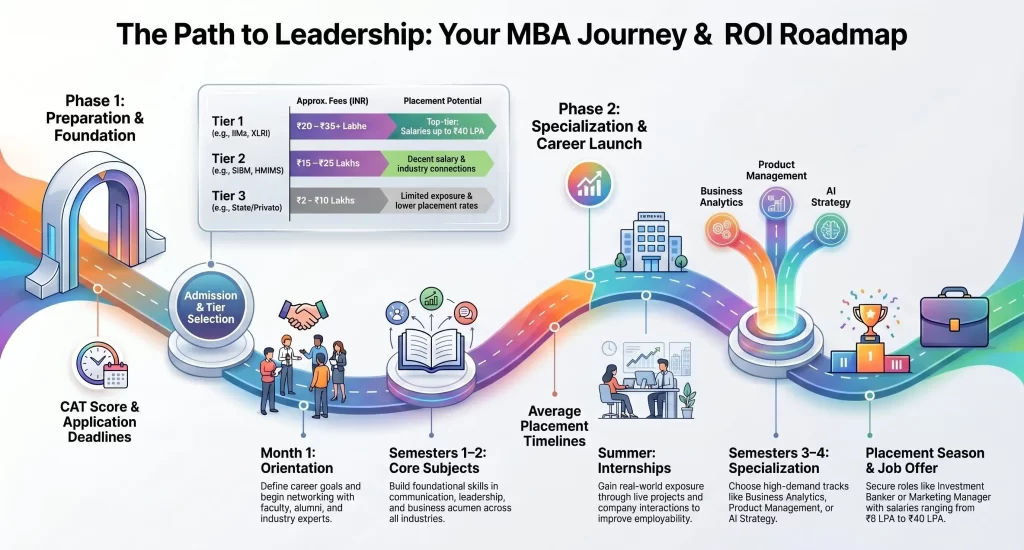
The job market has changed. Companies no longer just want management degrees — they want professionals who combine business strategy with digital fluency. An MBA, when chosen wisely, can fast-track you into leadership roles in consulting, finance, and product management, with salaries ranging from ₹8 LPA to ₹40 LPA.
In this guide, you’ll get: top MBA specialisations for 2026, real salary data, college tier comparisons, 20 in-demand career options, and an honest take on when an MBA is and isn’t worth it.
This blog will find the answer to the question. It will also discuss the specialisations that an MBA provides, what the future holds, and job opportunities.
Key Takeaways
- An MBA opens doors to various high-paying career options. To ensure you make the right career choice, here are the key aspects of an MBA you should know:
- An MBA is a postgraduate degree for working individuals. But fresh graduates can also take early-management courses to secure employment more quickly.
- Specialisations in MBA include Business Analytics, International Business, Human Resource Management, and Product Management.
- You can choose between full-time, part-time, online, or distance MBA depending on your needs.
- The program opens doors to roles like Chief Executive Officer, Investment Banker, and Operations Analyst.
- You can opt for Tier 1, Tier 2, and Tier 3 MBA colleges, depending on your budget and placement considerations.
- Top MBA graduates can earn INR 20 LPA-INR 40 LPA in consulting, finance, and product roles (senior).
What Does MBA Stand For?
MBA stands for Master of Business Administration — a postgraduate degree that builds business, management, and leadership skills across industries like finance, marketing, and consulting.
Types of MBA Programs
An MBA prepares individuals to take on leadership roles in almost every industry. From banking and finance to digital marketing, executives and managers help organisations to prosper. To make MBA accessible to everyone, it comes in various types.
Each MBA program offers different levels of exposure and flexibility, such as:
Full-Time MBA: It is a 1-2 year program. Graduates who have just finished college and are looking for high-paying job opportunities can do a full-time MBA.
Part-Time MBA: Classes take place in the evenings and on weekends. Working professionals can benefit from a part-time MBA by upgrading their skills while securing their current job.
Executive MBA (EMBA): Professionals seeking senior leadership roles, such as Chief Executive Officer (CEO) or Chief Technology Officer (CTO), can pursue an Executive MBA. It requires 5-15 years of experience to pursue the program and helps enhance your leadership skills.
Online MBA: It offers flexible learning to students and working professionals. You can understand trending business practices without travelling, and you can clear your doubts in every session.
Distance MBA: Many people think an MBA is a costly program. But a distance MBA is a cost-effective option. It also offers pre-recorded lessons from experts, which allows everyone to learn at their own pace while meeting professional or personal commitments.
Core Skills You Gain from an MBA
Learning the types of MBA will help you understand which fits your time and goals. Each of them helps strengthen soft and technical skills. To build a prosperous business career, the core skills you gain from an MBA include:
- Communication skills
- Business acumen
- Leadership abilities
- Networking
- Relationship building
- Collaboration and teamwork
Top 10 MBA Specialisations for 2026
Once you gain skills from an MBA, the next step is to choose a specialisation. The program spans various international business, human resources, marketing, business analytics, and more. Depending on your objectives, MBA specialisations for 2026 include:
Marketing: Focuses on consumer behaviour, branding, and digital marketing. Individuals can pursue an MBA in marketing to find suitable roles in sales, advertising, and brand management.
Human Resource Management (HRM): Covers recruitment, training, and employee management. If you’re passionate about organisational development, an MBA can help you secure senior HR roles.
Finance: Focuses on investment, financial planning, and corporate finance. It is ideal for roles in banking, financial services, and consulting.
International Business: You can explore careers in multinational companies, as they deal with cross-border trades and exports.
Business Analytics: It involves business strategy and data analysis. You can combine these elements to find opportunities in data-driven professions.
Product Management: Helps individuals learn to create and manage products from idea to execution. Such a job is highly relevant in tech and startup landscapes.
Healthcare Management: The healthcare sector has a growing demand for managerial positions. An MBA can prepare students or working individuals to manage hospitals and healthcare organisations.
Information Technology (IT) Management: It bridges the gap between business and technology. The program is suitable for individuals who seek to manage IT systems and bring digital transformation.
Entrepreneurship: Allows people to create and manage their own business. Innovation and startup strategies are the core areas of the program.
Operations Management is in demand across the service and manufacturing industries. Individuals who pursue an MBA in operations management can learn logistics, supply chain, and process proficiency.
Why Do People Choose an MBA as a Career Option?
Once you know what specialisation you will choose in MBA, it will help you understand your career prospects. The program can help you gain practical business knowledge across industries, such as healthcare, banking, marketing, manufacturing, and more.
People also choose an MBA as a career option because:
Career Growth and Leadership Opportunities
An MBA prepares students for leadership roles in their early careers. It helps them learn how to manage teams and make strategic decisions that many companies seek from their leaders.
Higher Salary Potential
People also choose an MBA because it offers high earning potential. With specialisations in product management or consulting, the salary range will increase.
Career Switching Opportunities
An MBA makes it easier to switch careers. So, if you wonder whether an MBA is worth it after engineering? The answer is yes. You can gain a strong foundation in business principles that can help you move to consulting or marketing.
Networking and Industry Exposure
An MBA help individuals connect with industry experts, faculty, and alumni. Pursuing an MBA from a good business school also extends opportunities for internships, live projects, and company interactions. It will help you better understand real-world business environments.
Entrepreneurship and Startup Opportunities
Individuals who want to start their own business can pursue an MBA. It will give you an understanding of marketing strategies, business planning, and funding that can support you in starting new ventures.
Should You Pursue an MBA in 2026? Pros, Cons & Key Factors
By now, you know the reason to choose an MBA as a career option. The high salary potential, opportunities to switch careers, and networking highlight that an MBA is a stable choice in 2026.
The job market is witnessing rapid change in digital growth. To adapt to the change, companies require professionals to combine business knowledge and practical skills. With an MBA, you can gain expertise in business strategy and also learn leadership skills, which will help you explore senior roles.
When is an MBA a Good Career Option?
Individuals with clear career objectives can benefit from an MBA. If your goal is to move to management positions, you can do an MBA in fields like consulting, product management, or corporate strategy.
An MBA also helps add value in business understanding. When companies find out you have strong business acumen, it helps you land better jobs with lucrative salaries.
When MBA May NOT Be Worth It?
An MBA may not be worth it when you don’t have clear goals. As the program surrounds various specialisations, your skills/interest should match a particular field.
Students also pursue an MBA from a college with limited placements. It highlights that not every student may enter the job sector. Thus, it can hinder your career growth.
Is BBA + MBA a Good Career Option?
After passing the class 12 exam, many students wish to learn about business principles. An undergraduate Bachelor of Business Administration (BBA) program provides a strong foundation in business management and administration.
To strengthen management concepts, students can opt for an MBA later. It helps them gain practical experience through internships and projects, increasing their chances of landing high-paying jobs.
Key Decision Factors to Consider
After understanding the worth of an MBA, you can choose the course to enhance your management knowledge and practical skills. To make the right choice, you should consider the following factors:
Career goals: Be clear about the role or industry you want to enter.
Work experience: Some roles, particularly executive positions (CEO, CTO, etc.), prefer candidates with prior experience.
College and program quality: A reputable school offers better exposure and placement opportunities.
Fees vs. ROI: Compare the cost of the degree with salary outcomes.
Specialisation choice: Pick a field that matches market demand and your skills.
MBA Fees in India by College Tier
Knowing the worth of an MBA will take you to the next step. It is pursuing it from a good college. When choosing a college, you should also consider its fees.
Usually, MBA fees in India vary depending on the college, brand value, and placement outcomes. An institute that boasts a 100% placement rate may charge more because it has better faculty and stronger industry exposure.
On the other hand, colleges with weak faculty may charge less. But it doesn’t guarantee placements either.
Let’s understand the MBA fees breakdown by college tier:
Tier 1
Indian Institute of Management (IIMs), Xavier School of Management (XLRI), and Faculty of Management Studies (FMS), Delhi are Tier 1 colleges. Their fees range from INR 20 Lakhs to INR 35+ Lakhs, as they offer strong alumni networks and the best placements.
Tier 2
Tier 2 MBA colleges include IIMs such as Ranchi, Trichy, and Raipur. It also has private schools like SIBM Pune (Symbiosis Institute of Business Management), GIM Goa (Goa Institute of Management), and NMIMS Mumbai (Narsee Monjee Institute of Management Studies).
The fees at these colleges range from INR 15 to INR 25 Lakhs. They offer decent salary opportunities and good industry connections.
Tier 3
Private universities such as Amity University and Lovely Professional University fall into this category. There are also state-run colleges, such as the Pune University Department of Management Sciences (PUMBA) and Banaras Hindu University (BHU), that charge fees ranging from INR 2 Lakhs to INR 10 Lakhs. The fees are comparatively less in these colleges due to limited placement and exposure.
You can take a look at the following table that highlights the top 10 colleges and their fees:
| College Name | Approx. Fees (INR) |
| IIM Ahmedabad | ₹25-30 Lakhs |
| IIM Bangalore | ₹24-28 Lakhs |
| Indian School of Business (ISB) Hyderabad | ₹ 30-35 Lakhs |
| XLRI Jamshedpur | ₹23-25 Lakhs |
| FMS Delhi | ₹2-3 Lakhs |
| S. P. Jain Institute of Management and Research (SPJIMR) Mumbai | ₹20-24 Lakhs |
| NMIMS Mumbai | ₹18-22 Lakhs |
| Symbiosis Pune (SIBM) | ₹20-24 Lakhs |
| Institute of Management Technology (IMT) Ghaziabad | ₹12-15 Lakhs |
20 High- Paying MBA Career Options in Demand (2026)
After learning about the MBA colleges, you may be curious about the career options. As the program spans various fields such as healthcare, IT, consulting, and finance, students can find promising career opportunities.
Here are the top 20 in-demand MBA career options that offer lucrative packages:
Logistics manager
Ensures smooth movement of goods in companies and manages supply chain operations. They play a key role in cost control and efficiency.
Marketing manager
They strong demand in digital-first companies. Their roles include building brand strategies, leading campaigns, and driving customer engagement.
Business operations manager
Their roles include Prioritising business efficiency and performance. A business operations manager also oversees business activities and improves processes.
Human resources manager
A Human Resources (HR) manager is essential for talent-driven businesses. They handle hiring, employee engagement, and workplace culture.
Purchasing manager
Purchasing managers help reduce costs and maintain service quality in organisations. Their roles include building relationships with vendors and creating procurement strategies.
Financial analyst
They analyse financial data and support investment decisions. A financial analyst can unlock their true potential in banks and finance teams.
Operation analyst
An operations analyst works with strategy and operations teams. They use data to improve business performance.
Investment banker
If you’re looking for top career options in commerce without maths after 12th, then an investment banker is an ideal choice. Their role involves handling large financial deals, mergers, and acquisitions. Also, it is a high-paying job in finance.
Management consultant
It is a highly demanding career option in consulting firms. A management consultant advises companies on business growth and strategies.
Chief executive officer (CEO)
A CEO is an executive role that requires years of experience. They lead the overall direction of a company.
Finance manager
They manage budgeting, financial planning, and risk. Using these skills, they take part in a company’s decision-making process.
Product manager
You can work with tech, design, and business teams. Your role will be to develop a product from idea to launch.
Business intelligence analyst
A business intelligence analyst helps companies make data-driven decisions. They turn data into actionable insights.
Marketing director
You will ensure long-term brand growth. It is a leadership role to enhance marketing strategy and team performance.
Chief financial officer
It is a highly respected role in corporate finance. Their job is to supervise all the company’s financial activities.
Medical director
As a medical director, you need to have domain knowledge and management skills. Your role will include managing healthcare operations and the clinical team.
Policy analyst
You have to work with research or government organisations to study policies and suggest improvements.
Information technology (IT) director
An IT director leads digital transformation and IT strategy. Their years of experience matter in tech-driven companies.
Budget analyst
A budget analyst aligns financial principles with the organisation. They also plan and monitor budgets.
Sales director
As a sales director, you should focus on business growth and market expansion. You also lead the sales team and develop revenue strategies, leveraging the leadership skills from the MBA program.
Here is a table with the top 5 MBA career options, highlighting their primary roles and salary:
| Job Role | Primary Responsibilities | Average Salary (India) |
| Investment Banker | Guides clients towards strategic decisions Manages large financial deals, including mergers and acquisitions | INR 20 LPA-INR 40 LPA |
| Management Consultant | Problem identification Market research and competitive analysis Strategy development and planning | INR 15LPA-INR 30 LPA |
| Product Manager | Defines product vision Creates roadmaps for the product Drives product launches | INR 12 LPA-INR 25 LPA |
| Finance Manager | Prepares business activity reports and financial statements Monitors financial details | INR 10 LPA-INR 22 LPA |
| Marketing Manager | Develops marketing strategies Plans, executes, and optimises campaigns Manages social media platforms | INR 8 LPA-INR 20 LPA |
MBA Salary Trends in India
Now that you know the career options after an MBA, you may wonder how much the course will cost. MBA is one of the high-salary courses after 12th science. The program’s diversity also makes it accessible to both commerce and arts students.
Over the years, the salaries have improved. However, MBA salaries vary significantly by college, specialisation, industry, and work experience.
Premium business schools offer high salary packages. On the other hand, mid-tier colleges offer moderate salaries.
Here is a breakdown of MBA salary trends in India:
Salary by Specialisation
The employment sector offers diverse salary packages for each specialisation. The following are the MBA salaries by specialisation:
| Specialisation | Salary |
| IT and Product Management | INR 10 LPA-INR 12 LPA |
| Operations | INR 6 LPA-INR 15 LPA |
| Marketing | INR 6 LPA-INR 18 LPA |
| Business Analytics | INR 8 LPA-INR 22 LPA |
| Human Resources | INR 5 LPA-INR 12 LPA |
| Finance | INR 8 LPA-INR 20 LPA |
Salary Growth After 3–5 Years
Fresh graduates can pursue a BBA to gain expertise in business principles and basic management skills. It helps them get into the employment sector. But to increase earnings, students may choose an MBA.
The value of an MBA degree increases with at least 3-5 years of experience. It helps you move into mid-level management. Also, you can take your experience to other industries or companies, which can lead to salary hikes.
High-Paying MBA Roles in India
In India, people in leadership or management roles often receive high salaries. These roles include Marketing Director, Finance Manager or Investment Banker.
As they require strong decision-making abilities, their salaries are higher than those of other employees. With an MBA, you can enhance those skills and seek these positions across industries.
Emerging Roles (AI Era)
Artificial Intelligence (AI) is dominating every sector. While students are learning AI to innovate and use it in daily operations, companies need professionals to manage it.
Students passionate about AI technology and business can pursue an MBA. It will help you find high-paying roles as:
- Strategy Consultant: INR 15 LPA-INR 35 LPA
- Product Manager: INR 12 LPA-INR 30 LPA
- Data Analyst: INR 5 LPA-INR 15 LPA
- Business Analyst: INR 6 LPA-INR 18 LPA
Top Recruiters Hiring MBA Graduates
Learning about the salary trends will help you negotiate your salary with the recruiters. Since an MBA is a versatile degree, major industries such as e-commerce, technology, and consulting hire candidates.
We will look at the top MBA recruiters from India and abroad:
Top MBA Recruiters in India
In India, MBA graduates can find employment in companies across banking, technology, Fast-Moving Consumer Goods (FMCG), and e-commerce. The top Indian MBA recruiters are:
- Bain & Company
- Meesho
- ICICI Bank
- JP Morgan Chase
- Microsoft
Top International MBA Recruiters
MBA graduates can find leadership roles abroad. The international recruiters after an MBA degree include:
- Morgan Stanley
- KPMG
- Deloitte
- Coca-Cola
MBA vs Other Career Options
People may ask: Is an MBA a good career option in India, given other career options?
Popular options like Chartered Accountant (CA), M.Tech (Master of Technology), and entrepreneurship are often compared with MBA. It entirely depends on your interests and skills to choose a degree.
MBA vs M.Tech
MBA and M.Tech programs are both for students seeking in-depth knowledge and expertise. However, the two programs differ in focus.
M.Tech is a postgraduate engineering course. It offers technical expertise and specialisation in different engineering fields (civil, mechanical, or electrical).
An MBA offers business knowledge and skills in management practice. Therefore, transitioning to senior roles can benefit from an MBA degree.
MBA vs CA
Students, especially those in the commerce stream, often find it difficult to decide between an MBA and CA.
CA offers a specialised career in auditing, accounting, and taxation. But if you’re looking for broader career options, an MBA will be a better fit. It provides flexibility in finding leadership positions across marketing, corporate strategy, and finance.
MBA vs Entrepreneurship
Individuals who want to start their own business find entrepreneurship courses to be an ideal option. But it only focuses on starting and building a venture.
To know how to run or manage a business, you need to have management abilities. An MBA program provides a structure for learning business operations and management.
You can understand the comparison between an MBA and other career options from the following table:
| Factor | MBA | M.Tech | CA | Entrepreneurship |
| Cost | ₹2L-₹30L | ₹2L-₹10L | ₹2L-₹5L | Depends on the business |
| Time | 2 years | 2 years | 4-5 years | No fixed duration |
| Salary | INR 6 LPA- INR 25 LPA | INR 4 LPA- INR 15 LPA | INR 6 LPA- INR 20 LPA | Unpredictable |
| Risk | Low to moderate | Low | Low | High |
| Growth | Steady growth with leadership and managerial positions | Fast in technical roles | Strong in the finance sector | High but unpredictable |
MBA in India vs Abroad
Wondering whether you should do an MBA in India or abroad? It is a common concern. Studying for an MBA in India comes with promising placement opportunities and lower tuition fees.
However, pursuing an MBA abroad can be costly. Nevertheless, they provide a stable income due to their diverse industries.
No matter where you want to do an MBA, it will depend on cost, career goals, and long-term plans.
Cost Comparison
Cost is a major deciding factor in deciding to pursue an MBA. It will give you an idea whether you should pursue it in India or seek global exposure.
An MBA is more affordable in India. It may cost between ₹8 and ₹ 25 Lakhs. The cost usually depends on the college and specialisation you choose.
If you pursue an MBA abroad, it can cost around ₹50-₹80 Lakhs. International market standards for MBAs are higher. Hence, tuition and living expenses are higher than Indian fees.
Job Opportunities
An MBA provides ample job opportunities to students and working professionals. It usually depends on how you want to build your career.
An MBA in India helps you build a strong network with companies. You can explore core areas such as consulting, tech, and finance, where salaries are quite competitive.
Studying for an MBA abroad will give you exposure to diverse industries and markets. You can work as an investment banker, financial analyst, or sales director across financial services or e-commerce, which will help you earn promising salaries.
Who Should Choose India vs Abroad?
Depending on their career direction, a person should choose to pursue an MBA in India or abroad.
For instance, if you’re looking for an affordable degree with faster employment opportunities, you can stay in India and pursue an MBA.
Students who wish to explore international career opportunities will benefit from an MBA program abroad.
MBA for Freshers vs Experienced Professionals
Many students struggle to understand the time for an MBA. It is an idea that an MBA is only helpful for working individuals who want to switch to leadership positions.
Indeed, the program benefits them, but it is also helpful for fresh graduates.
The outcomes of an MBA for freshers and experienced professionals may be different.
MBA After Graduation (Freshers)
Doing an MBA right after graduation is a common choice for most students in India. It helps you enter the employment sector early with a strong foundation in management.
It also helps students switch their fields more easily with an MBA. For instance, if you have done B. Tech (Bachelor of Technology) in Civil Engineering, and you’re looking for managerial roles, an MBA will be helpful.
MBA After Work Experience
When individuals have work experience in business management, an MBA helps them hone their skills. For instance, you’re an entrepreneur and started a business. However, you may struggle to manage it or run its operations. An MBA will provide you with insights into operations that will strengthen your venture.
Future of MBA in the Age of AI (2026 and Beyond)
As the business landscape changes, people wonder: Is an MBA worth it in the future?
The answer is, yes. In fact, the MBA program is adapting to the future trends, such as AI, to reshape how businesses work. The program equips students with the skills to automate routine tasks and improve decision-making abilities, without replacing management roles.
In 2026 and beyond, companies will require people who understand both technology and business strategy. In such a scenario, AI remains relevant.
How AI is Changing Business Jobs?
Companies are not just hiring for knowledge. They are hiring for the ability to apply that knowledge in complex situations.
AI is reducing manual and repetitive work for businesses. The technology automates tasks such as data entry, reporting, and basic analysis.
To work with AI, companies are hiring professionals. People with an MBA can use problem-solving skills to leverage AI in operations, speeding up work and increasing productivity.
Will MBA Become Obsolete?
The advancement of technology is changing the business landscape. To adapt to the change, the MBA will evolve.
The program will focus more on AI-based, live projects, and internships to provide hands-on experience in managing a business. It means that MBA will not become obsolete; rather, it will value practical skills to strengthen companies.
Common Mistakes to Avoid Before Doing an MBA
Pursuing an MBA is a significant investment in time and money. But when you make any mistake, it can cost your career growth. It is essential to know what mistakes you should avoid when doing an MBA to make better decisions.
- Choosing the Wrong College: A business school with poor placements can limit your career opportunities. Assess the placement reports and rankings of the institutes before making a decision.
- Picking the Wrong Specialisation: Students often choose specialisation based on trends. You should know your interests and career goals to consider a suitable specialisation.
- Doing an MBA Without a Career Goal: Pursuing an MBA without a career plan can lead to confusion. You should know the need for the degree, be it for switching industries or roles, to get clarity on the MBA program.
How Does Career Planner Edu Fair Help to Choose a Career In MBA?
The various MBA specialisations often leave students confused. Without a clear career plan, it becomes challenging to pursue the program and land your dream job. In such a scenario, you can find appropriate guidance at the Career Planner Edu Fair.
We host an educational event where students and parents connect with top colleges and experts under one roof. You can engage in real-time discussions with the experts to gain clarity in your career goals. It will help you choose a specialisation in the MBA and unlock possible career options.
Make a Smart Career Investment with an MBA in 2026
Is an MBA a good career option? As the program adapts to the latest AI trends, the MBA has a promising future.
Freshers and working professionals can gain a strong grasp of business acumen through a self-paced MBA. Moreover, pursuing a specialisation from a reputed business school will increase your placement opportunities.
But if you’re still confused regarding choosing an MBA, you can seek guidance.
At Career Planner, we host the largest educational fair, where you can meet industry experts and representatives from top colleges. You can have a one-on-one discussion with the experts who will help navigate your interests.
Once you know what you’re looking for in an MBA program, you’ll be better able to understand your specialisation and career options. We can also help you explore international opportunities to accelerate your career growth through an MBA.
Make the right MBA decision. Attend the Career Planner Edu Fair and discover the best opportunities for your future.
FAQs
Is an MBA worth it in India in 2026?
An MBA in India in 2026 is highly valued when earned from top-tier institutions. Students can pursue the program from IIM, which will help them earn potential salaries of INR 25+ LPA. You can also gain industry exposure and analytical skills to work as Brand Managers or Human Resources Executives in good firms.
Can I do an MBA without work experience?
Yes, you can do an MBA without work experience. Various early-career management programs are available for fresh graduates. It will help demonstrate strong leadership potential, high academic merit, and relevant internships.
Which MBA specialisation is best?
The best MBA specialisations are in fields like Marketing, Business Analytics, and Corporate Finance. However, it entirely depends on your career goals which specialisation you will choose. By evaluating the goals, you can find lucrative roles in banking, tech, or brand management.
Can I get a 100% job after an MBA?
Top-tier business schools boast 100% placement rates. But the employability depends on the economic climate, specialisation, internship quality, and individual performance.
Who earns more, CA or MBA?
The career growth for both CA and MBA is promising. However, earning potential varies by focus. A CA with specialisation in tax or audit can earn around INR 7 LPA- INR 9 LPA. An MBA graduate from tier 1 colleges may earn between INR 15 LPA and INR 35 LPA.
What are the best MBA colleges in India?
Top MBA colleges in India include IIM Calcutta, XLRI Jamshedpur, IIM Bangalore, IIM Ahmedabad, and FMS Delhi. These colleges have strong industry reputations and require CAT or GMAT scores for admission.
Is an MBA worth it after 30?
Absolutely, you can do an MBA after 30. It provides a competitive advantage rather than a setback. At 30, your work experience can clarify your studies and increase your salary by 50%. You can pursue an MBA from a top-tier business school that values 6-8 years of experience.
Is an MBA worth taking a loan in India?
Taking an MBA loan is worth it in India if you are pursuing a degree from reputed colleges like IIM or XLRI. These institutes offer high placement packages and repayment terms, allowing you to repay in 1-2 years.
What is the average MBA salary in India?
The average MBA salary in India ranges between INR 6 LPA and INR 23 LPA. The salary range typically depends on the experience, school reputation, and specialisation. While top IIM graduates often receive over INR 30 LPA, freshers start at INR 4.5 LPA to INR 10 LPA.